Will AI Replace Aviation Jobs?
Commercial aviation already relies heavily on flight automation and computerised systems. But pilots provide essential judgment during emergencies, severe weather, and system failures. Air traffic controllers managing complex airspace separation and ground crews maintaining aircraft remain firmly human roles.
36 roles found
Air Traffic Controller (Mid-Level)
Air traffic controllers are protected by extreme FAA regulatory barriers, NATCA union power, life-safety liability, and deep cultural resistance to autonomous air traffic management. NextGen/ERAM/ADS-B tools augment situational awareness but the human remains the irreducible decision-maker for aircraft separation. Safe for 10+ years.
Aircraft Cargo Handling Supervisors (Mid-to-Senior)
Cargo ramp supervisors face dual pressure from AI-powered cargo management systems automating load planning and documentation tasks, while automation in warehousing shrinks the workforce they supervise. The human core — crew leadership, safety enforcement, hazmat oversight — persists, but the planning and coordination layers are being absorbed by AI. Adapt within 3-5 years.
Aircraft De-Icer Operator (Mid-Level)
Aircraft de-icer operators work outdoors in winter weather operating boom-mounted spray rigs to remove ice and snow from aircraft surfaces — a safety-critical task where missed contamination can cause a crash. Vestergaard's OPTIM-ICE (2024) is the most advanced system and it is explicitly "operator-assisted," not operator-replacing. No autonomous de-icing system exists in commercial deployment. The core work — visual ice assessment, holdover time judgment, and precise fluid application across dozens of aircraft types in freezing conditions — is protected by Moravec's Paradox and FAA safety mandates. Safe for 5+ years.
Aircraft Fueller (Mid-Level)
Aircraft fuellers handle Jet-A in a hazmat-regulated, safety-critical ramp environment where no autonomous refueling system is deployed or near production. Bonding, grounding, deadman valve operation, fuel quality sampling, and emergency spill response are physical, high-stakes tasks protected by DOT/IATA hazmat certification, TSA airside access, and the sheer complexity of connecting pressurised fuel to dozens of different aircraft types in all weather. Digital fuel management platforms are absorbing documentation and inventory reconciliation, but 75% of the job is hands-on physical work with hazardous materials. Safe for 5+ years.
Aircraft Groomer / Cabin Cleaner (Mid-Level)
Aircraft cabins are cramped, variable, and time-pressured environments where every cleaning task requires human hands between narrow seat rows, inside tight lavatories, and across galleys with complex equipment. Zero viable AI cleaning tools exist for aircraft interiors. 0.0% Anthropic observed exposure across all cleaning occupations. Safe for 10-15+ years.
Aircraft Load Planner (Mid-Level)
Aircraft load planning's computational core is already automated by specialist software (Jeppesen, AMADEUS Altéa FM, SITA). The human persists because regulators and airlines mandate human sign-off on safety-critical weight & balance, but centralization is steadily compressing headcount. Adapt within 2-5 years.
Aircraft Marshaller (Mid-Level)
Aircraft marshallers stand on an active airport apron, directly in front of multi-million-dollar aircraft, using hand signals and illuminated wands to guide pilots into parking positions with metre-level wingtip clearance. No AI system can replicate the real-time spatial judgment, split-second pushback coordination, and physical presence this role demands. VDGS augments final parking guidance, but the marshaller remains the irreducible human safety checkpoint. Safe for 5+ years.
Aircraft Painter (Mid-Level)
Aircraft painting in Part 145 MRO environments combines physically demanding spray booth craft with aviation-specific regulatory oversight, hazardous materials handling, and corrosion protection requirements that robotic systems cannot replicate on complex airframe geometries. Safe for 10+ years.
Aircraft Service Attendant (Mid-Level)
Core cabin cleaning tasks are physically protected — scrubbing galleys, wiping tray tables between narrow rows, and servicing lavatories under the fuselage are beyond any deployed robot. But restocking and turnaround coordination are displacing, neutral market evidence provides no uplift, and modest barriers keep this at 44.9. The physical work buys time; the structured aircraft environment erodes it. Transform within 3-7 years.
Airfield Operations Specialist (Mid-Level)
Transforming now — 60% of task time faces AI augmentation or displacement. FAA mandates and physical airfield presence buy 5-10 years, but documentation and routine inspections are automating steadily.
Airline Pilot (Mid-to-Senior Captain/First Officer)
Airline pilots are protected by the strongest combination of regulatory licensing, union power, liability stakes, and cultural trust of almost any profession. Autopilot and AI augment cruise-phase operations, but emergency authority, takeoff/landing judgment, and legal accountability remain irreducibly human. Safe for 10+ years.
Airport Baggage Handler (Entry-to-Mid Level)
Physical aircraft loading in cramped, irregular cargo holds protects the core of this role for 10-15 years, but conveyor sorting and tug driving are automating now. Adapt within 3-7 years.
Airport Bird Scarer / Wildlife Hazard Manager (Mid-Level)
Irreducibly physical role on active airfields — 55% of task time involves deploying pyrotechnics, flying falcons, and managing habitat where no AI or robot can operate. AI radar augments detection but human dispersal and judgment remain mandatory under ICAO/FAA/CAA regulations. Safe for 10+ years.
Airport Fire Officer / ARFF Firefighter (Mid-Level)
ARFF firefighters are federally mandated at every certificated airport and operate in extreme, unpredictable physical environments involving aircraft fires, fuel spills, and crash rescue. AI augments situational awareness but cannot enter a burning fuselage, rescue passengers, or apply foam to a fuel fire. Safe for 20+ years.
Airside Driver (Mid-Level)
Airside driving is irreducibly physical — operating tugs, fuel bowsers, baggage tractors, and crew buses across active aprons with live jet engines, moving aircraft, and constant FOD hazards. No autonomous airside vehicle has been deployed at any commercial airport. Safe for 10+ years.
Astronaut (Mid-to-Senior)
This role is among the most AI-resistant in the economy. The unstructured physical environment of space, extreme barriers to autonomous operation, and irreducible human presence requirements protect it for decades.
Aviation Communications and Frequency Coordination Manager (Mid-Level)
Protected by international treaty obligations and irreducible diplomatic coordination, but 55% of task time is being reshaped by AI spectrum analysis and automation tools. Safe for 5+ years with adaptation.
Aviation Surveillance and Code Coordination Manager (Mid-Level)
Protected by ICAO treaty obligations and irreducible international coordination, but 45% of task time is being reshaped by AI-powered surveillance analytics and automation tools. Safe for 5+ years with adaptation.
Avionics Technician (Mid-Level)
FAA-mandated human certification, hands-on electronic work on aircraft, and a persistent aviation maintenance shortage protect avionics technicians from displacement. Daily workflow is shifting as AI-driven diagnostics and predictive maintenance reshape troubleshooting. Safe for 10+ years.
Balloon Pilot (Mid-Level)
Among the most automation-resistant roles in aviation. No AI flight control system exists for hot air balloons, and none is in development. Safe for 10+ years.
Commercial Pilot (Mid-to-Senior)
Commercial pilots are protected by FAA licensing, personal liability for all souls on board, and the irreducible demands of operating in varied, unstructured environments — from low-altitude agricultural flying to mountain air ambulance operations. AI augments planning and cruise-phase workload but cannot replace the pilot's judgment, physical presence, or legal accountability. Safe for 10+ years.
Composite Repair Technician -- Aviation (Mid-Level)
Aviation composite repair is anchored by FAA/EASA-mandated human sign-off, irreducible physical craft on CFRP structures, SRM-governed processes, and an acute shortage of qualified technicians. AI augments damage assessment and NDT interpretation but cannot execute scarf repairs, vacuum bag layups, or autoclave curing on aircraft in service. Safe for 10+ years.
Drone Pilot — Commercial (Mid-Level)
Commercial drone piloting is protected today by Part 107/GVC licensing and mandatory physical presence, but autonomous flight platforms and AI-powered data processing are compressing the human piloting requirement toward mission supervision and data interpretation. Adapt within 3-7 years.
Flight Attendant (Mid-Level)
Flight attendants are protected by mandatory physical presence in a pressurized cabin, FAA minimum crew regulations, strong union representation, and core safety duties that have zero AI alternative. Service tasks are evolving with self-service technology, but safety and interpersonal management remain irreducibly human. Safe for 10+ years.
Page 1 of 2
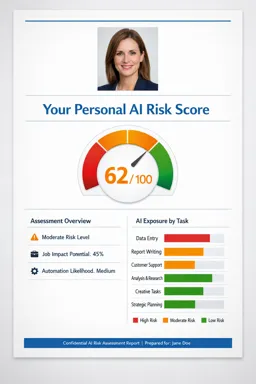
What's your AI risk score?
We're building a free tool that analyses your career against millions of data points and gives you a personal risk score with transition paths. We'll only build it if there's demand.
No spam. We'll only email you if we build it.
The AI-Proof Career Guide
We've found clear patterns in the data about what actually protects careers from disruption. We'll publish it free — but only if people want it.
No spam. We'll only email you if we write it.