Will AI Replace Warehousing Jobs?
Warehouse robotics and AI-driven inventory management are automating picking, packing, sorting, and shelving operations at increasing scale. Workers in large, standardised distribution centres face the most disruption, while those managing complex, irregularly shaped, or fragile inventory retain their roles longer.
18 roles found
Conveyor Operators and Tenders (Mid-Level)
Displacement underway. Automated conveyor systems, AGVs, AMRs, and AI-driven material handling already perform core conveyor operation tasks at scale. BLS projects decline through 2034 with only replacement openings sustaining the occupation.
Dispatch Operative (Mid-Level)
Automated labelling, auto-boxing, AI-powered quality inspection, and robotic palletising are displacing the core dispatch workflow. Vehicle loading and mixed-item packing persist but cover only 20% of task time. Act within 1-3 years at large DCs.
E-commerce Fulfilment Operative (Entry-to-Mid Level)
Warehouse-only e-commerce fulfilment is at the leading edge of robotics deployment — Amazon, Ocado, DHL, and ASOS-style operations are automating picking, packing, and sortation faster than any other manual occupation. Act within 1-3 years.
Forklift Truck Driver (Mid-Level)
Autonomous forklifts are production-ready and growing at 12-13% CAGR — but penetration is below 5% of the global installed base. The certification barrier and unstructured dock/yard work buy 3-5 years. Adapt now.
Goods Inwards Inspector (Mid-Level)
AI-powered vision systems (VIMAAN, Arvist, Keyence) now automate damage detection, quantity verification, and purchase order matching at receiving docks — the three tasks consuming 60% of this role's time. Physical handling of varied goods provides a thin barrier, but documentation and reconciliation tasks are near-fully automatable. Act within 2-4 years.
Goods-In / Goods-Out Operative (Mid-Level)
35% of task time — PO verification, WMS booking, dispatch documentation — faces near-certain displacement by WMS auto-receipt, RFID, and electronic proof-of-delivery systems already in production. The physical dock work (45% of time) provides modest protection, but structured loading-dock environments are increasingly fitted with conveyors, AMRs, and AI vision. Act within 2-4 years.
Industrial Truck and Tractor Operator (Entry-Mid)
Autonomous forklifts are production-ready and specifically target this role's core task — but adoption is running at less than 5% of the installed forklift base. The gap between what the technology CAN do and what warehouses ARE doing buys 3-5 years. That gap is closing at 12.8% CAGR. Adapt now.
Inventory Specialist (Mid-Level)
RFID/IoT sensors, AI-powered WMS, and automated reorder optimization are displacing the core task loop of cycle counting, variance analysis, and ERP data management. Act now — most mid-level inventory specialist tasks are already automatable by production-deployed tools.
Machine Feeders and Offbearers (Mid-Level)
Displacement underway. Robotic arms, cobots, AGVs, and AI-driven material handling systems already perform the core loading/unloading tasks at scale. Role declining and projected to shrink further through 2034.
Material Moving Workers, All Other (Mid-Level)
This catch-all category captures the least specialised material movers — the workers most directly displaced by AMRs, conveyor systems, and goods-to-person automation. With fewer barriers than named material moving roles and 45% of task time already facing displacement, the window to reskill is 2-4 years.
Packer and Packager, Hand (Entry)
95% of task time faces direct displacement from robotic packing systems already in production at Amazon, UPS, and FedEx. BLS projects employment decline. Act now — this role has a 2-4 year window before major headcount reductions in large facilities.
Reach Truck Operator (Mid-Level)
Autonomous reach trucks are production-ready and specifically target narrow-aisle pallet retrieval — but installed-base penetration remains below 5%. The precision demands of high-racking work buy slightly more time than general forklift operation. Adapt within 3-5 years.
Shipping, Receiving, and Inventory Clerks (Mid-Level)
60% of task time faces direct displacement by WMS automation, RFID tracking, and AI-powered inventory systems already in production. BLS projects employment decline through 2034. The clerical core of this role — verifying, recording, tracking — is exactly what software does best. Act within 1-3 years.
Stock Controller — Warehouse (Mid-Level)
RFID perpetual inventory, AI-powered WMS, and IoT sensor networks are displacing the core loop of cycle counting, stock record maintenance, and accuracy reporting. The physical investigation component provides marginal protection but cannot rescue a role whose primary output — accurate stock data — is now produced by automated systems. Act within 1-3 years.
Stocktaker / Inventory Counter (Mid-Level)
AI-driven RFID scanning, inventory drones, and automated counting systems are displacing the core manual counting work. Physical presence provides a temporary buffer, but 25% of task time is already fully displaced and 75% is being accelerated. Act within 2-4 years.
Warehouse Manager (Mid-to-Senior)
AI-powered WMS, warehouse robotics, and automated fulfilment systems are compressing the planning, coordination, and analytics layers of warehouse management — but labour leadership, safety accountability, and operational judgment on the floor persist. Adapt within 3-5 years.
Warehouse Operative (Mid-Level)
The physical manipulation barrier -- reaching, gripping, lifting diverse items in variable configurations -- keeps this role out of Red. But AMRs, goods-to-person systems, and robotic picking arms are transforming 65-70% of task time. Most SME warehouses remain manual, buying time that mega-facilities have already lost. Adapt within 2-4 years.
Warehouse Order Picker (Entry-to-Mid)
Warehouse order picking is at the epicentre of robotics deployment — goods-to-person AMRs, robotic picking arms, and automated sortation are displacing the core task loop. Act within 1-3 years at major employers.
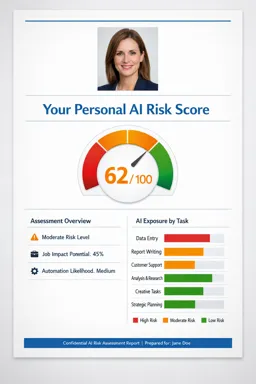
What's your AI risk score?
We're building a free tool that analyses your career against millions of data points and gives you a personal risk score with transition paths. We'll only build it if there's demand.
No spam. We'll only email you if we build it.
The AI-Proof Career Guide
We've found clear patterns in the data about what actually protects careers from disruption. We'll publish it free — but only if people want it.
No spam. We'll only email you if we write it.