Will AI Replace Respiratory Sciences Jobs?
Respiratory therapists manage ventilators, perform emergency airway procedures, and assess patients in acute and critical care settings. The hands-on, rapidly changing nature of respiratory emergencies and the judgment required for ventilator management keeps this specialism grounded in human work.
9 roles found
Asthma/COPD Specialist Nurse (Mid)
Chronic disease specialist combining clinical assessment, inhaler technique education, and patient self-management coaching. 43% of daily work involves AI-accelerated workflows (protocol-driven reviews, triage, documentation), but hands-on spirometry, inhaler training, and therapeutic relationships with chronic patients keep the role in the Green Zone. Safe for 10+ years; daily workflow transforming substantially.
Home Ventilation Specialist (Mid-Level)
Community-based respiratory clinician managing patients on home ventilators, CPAP, and BiPAP. 40% of daily work involves hands-on equipment setup, mask fitting, and patient education that AI cannot perform. Exactly 20% of task time involves AI-accelerated workflows (remote monitoring triage and documentation). Safe for 15+ years; the home environment adds physical unpredictability that deepens protection beyond hospital-based respiratory therapy.
Pediatric Pulmonologist (Mid-to-Senior)
Pediatric bronchoscopy in tiny airways, lifelong cystic fibrosis management, and ventilator care of critically ill children create a triple physical-interpersonal-accountability moat. AI augments documentation and imaging but cannot thread a bronchoscope through a 3-year-old's airway or counsel a family through a CF diagnosis. Safe for 10+ years.
Perfusionist / Cardiovascular Perfusionist (Mid-Level)
Operating heart-lung machines during open-heart surgery and managing ECMO circuits requires irreducible physical presence, split-second life-or-death decisions, and hands-on dexterity that no AI system can perform. With only ~4,000 practitioners in the US, acute workforce shortage, and zero autonomous AI tools for core tasks, this role is deeply protected for 15-25+ years.
Polysomnographic Technologist (Mid)
HSAT volume migration and AI sleep scoring are compressing the traditional in-lab role. Physical electrode work and overnight patient management protect the core, but the diagnostic model is shifting. Adapt within 3-5 years.
Pulmonologist (Mid-to-Senior)
Pulmonologists combine subspecialty diagnostic reasoning with hands-on procedures (bronchoscopy, thoracentesis) and critical care ventilator management. AI augments imaging interpretation and documentation but cannot perform bronchoscopy, manage a crashing ventilated patient, or bear malpractice liability. Safe for 15+ years.
Respiratory Physiologist (Mid-Level)
AI-powered spirometry interpretation and automated polysomnography scoring are production-ready and transforming 72% of this role's task time. Only 10% of daily work is purely physical, and diagnostic pattern recognition — the core skill — is a primary AI capability. Adapt within 3-5 years.
Respiratory Therapist (Mid-Level)
Airway management, ventilator operation, and emergency response anchor this role firmly in the Green Zone. 30% of daily work is pure physical intervention that no AI system can perform, and another 65% is human-led clinical care that AI merely assists. Safe for 15-25+ years.
Sleep Physiologist (Mid-Level)
AI-powered automated polysomnography scoring and domiciliary sleep screening analysis are now FDA-cleared and production-deployed, transforming 55% of this role's task time. The interpretive core — sleep staging, respiratory event detection, arousal scoring — is a primary AI capability with the largest validation datasets in sleep diagnostics. Adapt within 3-5 years.
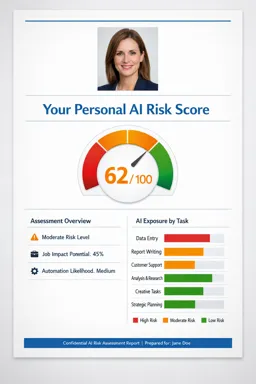
What's your AI risk score?
We're building a free tool that analyses your career against millions of data points and gives you a personal risk score with transition paths. We'll only build it if there's demand.
No spam. We'll only email you if we build it.
The AI-Proof Career Guide
We've found clear patterns in the data about what actually protects careers from disruption. We'll publish it free — but only if people want it.
No spam. We'll only email you if we write it.