Will AI Replace Rail Jobs?
Rail operations combine automated signalling systems with human judgment for maintenance, freight operations, and passenger safety decisions. AI optimises scheduling and enables predictive maintenance, but locomotive engineers and track maintenance crews handle the physical realities of rail infrastructure daily.
22 roles found
Level Crossing Keeper (Mid-Level)
Network Rail is actively automating and closing manually-operated level crossings, replacing on-site keepers with CCTV-monitored remote operation from Rail Operating Centres and MCB-OD (obstacle detection) systems. The ~700 manual crossings in the UK are declining by 30-50 per year. This role is being eliminated through technology displacement. Act within 2-5 years.
Locomotive Engineer (Mid-Level)
Locomotive engineers face long-term displacement from autonomous freight technology, but FRA certification mandates, BLET union power, and the reality that no autonomous freight train operates on US mainlines without a crew mean the role transforms over 10-20 years rather than disappearing soon.
Overhead Line Engineer — Railway (Mid-Level)
Physical work at height on 25kV live catenary in unstructured railway environments, combined with acute UK skills shortage and strong union/regulatory barriers, makes this role highly AI-resistant. Electrification expansion (CP7, HS2) sustains demand through 2030+. Safe for 10+ years.
Permanent Way Inspector (Mid-Level)
Walking surveys, manual gauge measurement, and safety-critical track sign-off in unstructured outdoor rail corridors are irreducible physical tasks. AI-powered track geometry analytics and drone surveys augment inspection data but cannot replace the PWI's field judgment or regulatory authority. Safe for 5+ years.
Platform Attendant (Mid-Level)
Platform attendants are protected by irreducible safety duties at the platform-train interface, strong union representation (RMT, TSSA, ATU), and physical presence requirements in unpredictable station environments. But automated announcements, ticket barriers, and CCTV monitoring are steadily absorbing information and revenue protection tasks. Adapt within 3-7 years.
Rail Car Repairer (Mid-Level)
FRA-mandated human inspections, heavy physical work in unstructured rail yard environments, and strong union protections make this a highly AI-resistant trade. Safe for 10+ years with AI augmenting diagnostics but not displacing hands-on repair.
Rail Dispatcher / Train Controller (Mid-Level)
Rail dispatchers are protected by FRA certification requirements (US), Network Rail competency frameworks (UK), strong union representation (SMART-TD/ATDA/TSSA), and the irreducible complexity of real-time disruption management across interdependent network segments. ERTMS and AI-powered traffic management systems are transforming monitoring and scheduling workflows, but conflict resolution during disruptions and safety-critical priority decisions remain human-led. Safe for 10+ years with significant daily work transformation.
Rail Yard Engineers, Dinkey Operators, and Hostlers (Mid-Level)
Rail yard locomotive operators face steady erosion from Remote Control Locomotive (RCL) technology and Precision Scheduled Railroading (PSR) crew reductions. The physical hands-on work — coupling cars, inspecting equipment, securing brakes — resists automation, but the core driving task is directly vulnerable to RCL displacement. Tiny occupation (3,100 workers) with flat wages and no active hiring growth. Union and physical presence barriers provide moderate protection. Adapt within 3-5 years.
Railroad Brake, Signal, and Switch Operators and Locomotive Firers (Mid-Level)
This occupation combines obsolete (locomotive firer) and declining (brake/signal/switch operator) roles. The physical yard work resists full automation, but Remote Control Locomotives, PTC, and automated inspection systems are displacing 40% of task time. Workforce shrinking (-19% since 2023), flat wages, no active hiring. Union and regulatory barriers provide moderate protection. Adapt within 2-5 years.
Railroad Conductor and Yardmaster (Mid-Level)
Railroad conductors and yardmasters sit at the Yellow-Green boundary. The physical and safety-critical core work resists automation, but Precision Scheduled Railroading is shrinking headcount and AI-augmented dispatch is transforming operations. Strong union and regulatory barriers buy time. Adapt within 3-7 years.
Signal and Track Switch Repairer (Mid-Level)
Hands-on installation, inspection, and repair of railroad signaling systems, track switches, and PTC electronics in outdoor, unstructured environments cannot be automated — FRA-mandated testing intervals and aging infrastructure sustain demand. Safe for 5+ years.
Signalling Tester (Mid-Level)
IRSE-licensed safety-critical testing on live railway infrastructure in unstructured trackside environments makes this role deeply AI-resistant. Mandatory human sign-off on interlocking and functional tests, acute UK skills shortage, and ETCS migration demand protect the role. Safe for 10+ years.
Signalling Tester In Charge / STIC (Mid-Level)
Safety-critical physical testing in unstructured trackside environments, IRSE licensing, and personal go/no-go certification authority make this one of the most AI-resistant roles in rail engineering. Acute skills shortage and ETCS rollout sustain structural demand for decades. Safe for 15+ years.
Station Master / Station Manager (Mid-to-Senior)
Station managers are protected by mandatory physical station presence, safety accountability, union agreements, and irreducible emergency response duties. Admin, scheduling, and reporting tasks are transforming via AI augmentation. Safe for 5+ years but the daily work is shifting significantly.
Subway and Streetcar Operator (Mid-Level)
Driverless metro technology is proven and deployed in 60+ cities worldwide, but existing US legacy systems face decade-long retrofit timelines and powerful union protection. The role transforms slowly rather than disappearing quickly.
Track Machine Operator (Mid-Level)
Track machine operators are protected by physical presence on live railway corridors during night possessions, operating specialist heavy plant (tampers, ballast regulators, rail grinders, stoneblowers) that requires continuous human judgment in unstructured, safety-critical environments. CPCS/Sentinel certification and strong union representation reinforce protection. Safe for 5+ years with stable demand driven by infrastructure renewal programmes.
Track Worker / Plate Layer (Mid-Level)
Track workers are protected by irreducible manual labour in unstructured, hazardous railway environments where no robotic or AI system can operate. Strong union representation and safety regulations reinforce physical protection. Safe for 5+ years with stable demand driven by infrastructure investment and ongoing track degradation.
Train Driver, UK Mainline (Mid-Level)
UK train drivers are protected by ASLEF union power, safety-critical licensing, and the enormous cost of retrofitting Network Rail's legacy infrastructure for autonomous operation. Driverless technology is proven on closed systems (DLR) and GoA2 ATO operates on Thameslink, but mainline driverless operation on mixed-traffic routes with level crossings is 15-25+ years away. Safe for 10+ years with incremental workflow changes as digital signalling expands.
Train Guard (Mid-Level)
Train guards have strong AI resistance on core safety-critical tasks but face existential pressure from Driver-Only Operation (DOO), an operational automation trend that predates AI. Strong union and regulatory barriers are the primary defence. Adapt within 3-7 years.
Train Guard / Conductor (Mid-Level)
UK train guards face a genuine existential question: Driver Only Operation (DOO) is expanding across TOCs, the East West Rail DOO dispute crystallises the threat, and automated ticketing erodes revenue protection work. Strong RMT union resistance and physical safety requirements buy time, but the role's long-term trajectory points toward reduction rather than growth. Adapt within 2-5 years.
Train Guard / Conductor (UK) (Mid-Level)
UK train guards face an existential structural threat that train drivers do not: Driver-Only Operation (DOO/DCO) is actively expanding across the network, with ~30% of UK rail journeys already operating without a guard. RMT union opposition is the primary barrier keeping guards on trains. Adapt within 3-5 years as DOO decisions by individual TOCs reshape the workforce.
Tram Driver (Mid-Level)
Driverless tram technology exists and is deployed on isolated systems globally, but most tram networks share road space with traffic and pedestrians -- making full automation significantly harder than enclosed metro systems. Union protection and infrastructure retrofit costs buy 10-15+ years for incumbent operators.
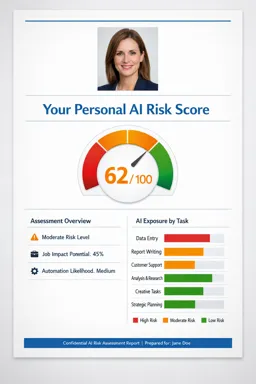
What's your AI risk score?
We're building a free tool that analyses your career against millions of data points and gives you a personal risk score with transition paths. We'll only build it if there's demand.
No spam. We'll only email you if we build it.
The AI-Proof Career Guide
We've found clear patterns in the data about what actually protects careers from disruption. We'll publish it free — but only if people want it.
No spam. We'll only email you if we write it.