Will AI Replace Pharmacy Jobs?
AI automates drug interaction checking, dose calculations, and prescription processing with high accuracy. Pharmacists who provide clinical consultation, manage complex medication regimens for multi-morbid patients, and counsel on adherence face less disruption than those focused solely on dispensing.
14 roles found
Antimicrobial Stewardship Pharmacist (Mid-Senior)
Clinical judgment in antibiotic selection and resistance management protects the core role, but 40% of task time is transforming as AI handles surveillance analytics, guideline compliance audits, and program reporting. Safe for 5+ years; the pharmacist directs the stewardship strategy while AI crunches the data.
Clinical Pharmacist — Ward-Based (Mid-Level)
Ward-based clinical pharmacists are protected by licensing, liability, and the irreducibly human nature of bedside clinical decision-making. AI augments medication review and interaction checking but cannot replace the MDT consultation, independent prescribing authority, or patient counselling that define this role. Safe for 7+ years, with the daily work shifting toward AI-validated clinical workflows.
Clinical Pharmacologist (Mid-to-Senior)
This role is protected by deep specialist expertise, licensing, and clinical accountability — but 25% of task time is shifting as AI handles formulary analytics, regulatory document preparation, and pharmacovigilance signal detection. Safe for 5+ years; the work evolves toward more complex judgment.
Consultant Pharmacist (Senior)
The most senior clinical pharmacist role in the NHS is protected by irreducible clinical leadership, personal prescribing liability, and deep interpersonal trust with patients and MDTs. Only 15% of task time faces meaningful AI transformation. Safe for 10+ years.
Medicines Information Pharmacist (Mid-Level)
The core of this role — answering drug queries by searching literature and synthesising evidence — is directly in the path of AI language models and agentic research tools. Licensing and liability for clinical advice protect against full displacement, but 85% of task time is already AI-exposed. Transform toward complex clinical advisory and specialist pharmacovigilance within 2-5 years.
Medicines Optimisation Pharmacist (Mid-Senior)
This role is protected by clinical judgment, licensing, and patient trust — but 35% of task time is shifting as AI handles guideline compliance, formulary audits, and medicines reconciliation. Safe for 5+ years; the work changes, not the headcount.
Non Medical Prescriber (Mid-Level)
NMPs are structurally protected by prescribing licensing (V300), personal clinical liability, and the irreducible requirement to physically assess patients and exercise independent clinical judgment. AI handles documentation and augments medication review, but the core prescribing decision remains firmly human. Safe for 10+ years.
Oncology Pharmacist (Mid-to-Senior)
Oncology pharmacists are deeply protected by lethal-stakes accountability, mandatory physical compounding of hazardous drugs, and credential barriers that no AI pathway can replicate. The role is transforming through AI-augmented dosing tools but core clinical functions remain irreducibly human. Safe for 10+ years.
Pharmacist (Mid-Level)
Dispensing is being automated at scale — robotic hubs now fill 60% of prescriptions at major chains. But clinical pharmacist services (immunizations, medication therapy management, chronic disease counselling) are growing and cannot be automated. Transform from dispenser to clinician within 3-5 years.
Pharmacogenomics Specialist (Mid-Level)
AI variant interpretation and CPIC guideline engines are automating the analytical core of PGx prescribing advice — the drug-gene interaction lookups, dosing algorithms, and CDS alert generation that define 45% of this role's task time. The psychosocial counselling and complex polypharmacy judgment remain human, but the field's small workforce and narrow clinical niche make it structurally fragile. Adapt within 3-5 years.
Pharmacy Aide (Mid-Level)
Pharmacy aides perform the most routine, least-protected tasks in the pharmacy hierarchy — stocking, cashiering, data entry, and filing. Every core task is either already automated or trivially automatable by agentic AI and robotic systems. Employment has been declining for over a decade and BLS projects near-zero growth. Act within 1-3 years.
Pharmacy Informatics Specialist (Mid-Senior)
Core work — bridging pharmacy operations and health IT systems via CPOE configuration, CDS rule design, and medication-use analytics — is being significantly accelerated by AI-embedded EHR features and automated CDS engines. The pharmacy-domain knowledge and clinical safety accountability keep this from collapsing, but adapt within 3-5 years as AI-native platforms absorb routine informatics tasks.
Pharmacy Technician (Mid-Level)
Robotic dispensing is production-grade and deployed at scale — CVS and Walgreens central fill hubs already process thousands of prescriptions daily with minimal human involvement. The core tech workflow (count, label, bottle, bill) is the exact use case automation was built for. Act within 1-3 years.
Radiopharmacist (Mid-Level)
This role's core work — aseptic preparation and quality control of radioactive medicines in shielded hot-lab environments — has no viable AI or robotic substitute. The theranostics revolution is expanding demand. Safe for 10+ years.
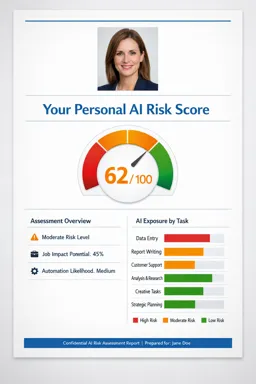
What's your AI risk score?
We're building a free tool that analyses your career against millions of data points and gives you a personal risk score with transition paths. We'll only build it if there's demand.
No spam. We'll only email you if we build it.
The AI-Proof Career Guide
We've found clear patterns in the data about what actually protects careers from disruption. We'll publish it free — but only if people want it.
No spam. We'll only email you if we write it.