Will AI Replace Logistics & Supply Chain Jobs?
AI transforms demand forecasting, inventory optimisation, and end-to-end supply chain visibility with increasing sophistication. Professionals who manage strategic supplier relationships, navigate global disruptions, and make complex sourcing decisions under uncertainty bring judgment that algorithms support but fundamentally cannot replace.
21 roles found
Aircraft Load Planner (Mid-Level)
Aircraft load planning's computational core is already automated by specialist software (Jeppesen, AMADEUS Altéa FM, SITA). The human persists because regulators and airlines mandate human sign-off on safety-critical weight & balance, but centralization is steadily compressing headcount. Adapt within 2-5 years.
Cargo and Freight Agent (Mid-Level)
Digital freight platforms already automate 55% of task time — documentation, tracking, rate calculation, and routing execute end-to-end without human involvement. Carrier negotiation and exception handling persist but cannot sustain the role at current headcount. Act within 2-4 years.
Customs Broker (Mid-Level)
AI platforms are automating entry filing, duty calculation, and compliance screening — 35% of task time already displaced. The CBP licence and tariff classification judgment provide meaningful barriers, but mid-level brokers handling routine entries face significant compression within 3-5 years.
Dangerous Goods Safety Adviser (Mid-Level)
Regulation protects the role's existence but not its current shape — 75% of task time faces AI acceleration. Barriers buy 5-7 years. Upskill or get compressed.
Demand Planner (Mid-Level)
The core of demand planning — statistical forecasting, data cleansing, model management, and accuracy reporting — is precisely what AI does best. Blue Yonder, o9 Solutions, SAP IBP, and Kinaxis already automate baseline forecast generation end-to-end, achieving 8-15% MAPE versus 35-45% for manual methods. The cross-functional S&OP coordination and exception management provide some resistance, but 50% of task time faces direct displacement. Act within 1-3 years.
Dispatcher, Except Police, Fire, and Ambulance (Mid-Level)
Transforming now — 60% of task time exposed to AI acceleration or displacement. AI routing and scheduling platforms automate the operational core while real-time human coordination persists. Adapt within 3-5 years.
Event Freight Coordinator (Mid-Level)
Transforming now — 65% of task time is exposed to AI automation, but the 20% spent on-site at venues is irreducible. Barriers buy 3-5 years. Digital logistics work compresses; physical venue work persists.
Fleet Manager (Mid-to-Senior)
Fleet managers face accelerating pressure as AI-powered telematics, predictive maintenance, and route optimisation automate the operational coordination layer — but driver management, safety accountability, vendor negotiations, and DOT/FMCSA compliance persist. Adapt within 3-5 years.
Forklift Operator / FLT Driver (Mid-Level)
Autonomous forklifts are production-ready and growing at 12% CAGR — but penetration remains below 5% of the global installed base. The deployment gap and dock/yard complexity buy 3-5 years. Adapt now.
Freight Broker / Transportation Broker (Mid-Level)
Digital freight platforms and AI-powered load matching are compressing the intermediary function that defines this role. Commission-based brokerage persists for complex and relationship-driven freight, but algorithmic matching handles an expanding share of standard loads. Act within 2-5 years.
Freight Forwarder / Freight Agent (Mid-Level)
Digital freight platforms automate 35% of task time outright and accelerate another 20% — documentation, tracking, and rate calculation execute end-to-end without human involvement. Customs compliance and exception handling persist but cannot sustain current headcount. Act within 2-5 years.
Freight Forwarding Operator (Mid-Level)
Digital freight platforms automate 55% of task time outright — booking, documentation, tracking, and rate calculation execute end-to-end without human involvement. Carrier negotiation and exception handling persist but cannot sustain current headcount at the operational level. Act within 2-5 years.
Import/Export Coordinator (Mid-Level)
Customs documentation, HS classification, and trade finance administration are highly structured and already executing end-to-end on AI-powered GTM platforms — 50% of task time displaced outright. Compliance checking and exception handling persist but cannot sustain current headcount. Act within 2-4 years.
Inventory Controller (Mid-Level)
AI-driven WMS platforms and demand forecasting tools are automating the analytical core of this role. 85% of task time is exposed to agentic AI acceleration or full displacement. Act within 1-3 years.
Load Planner (Mid-Level)
Vehicle load planning is a constrained optimization problem that AI solvers handle exceptionally well. Production-ready software (Cube-IQ, Blue Yonder, Manhattan Active TMS) automates load building, weight distribution, and route-sequenced loading end-to-end. The physical cargo judgment and driver coordination tasks provide some resistance, but 60% of task time faces direct displacement. Act within 1-3 years.
Logistics Coordinator (Mid-Level)
The operational core of this role -- shipment tracking, documentation, and rate calculation -- is being automated by digital freight and TMS platforms. But carrier relationship management, customs exception handling, and multi-party problem-solving keep the human coordinator essential for now. 60% of task time scores 3+. Adapt within 3-5 years.
Ship Broker (Mid-Level)
AI is automating market analytics, vessel matching, and post-fixture documentation, but fixture negotiation, sale & purchase deal-making, and deep shipowner/charterer relationships remain human-led. Adapt within 3-5 years or risk displacement to platform-equipped competitors.
Ship Chandler (Mid-Level)
Transforming now — 85% of task time involves AI-automatable workflows. Physical dockside delivery and supplier relationships buy 3-5 years, but procurement, documentation, and logistics coordination are compressing fast.
Third-Party Logistics (3PL) Account Manager (Mid-Level)
AI-powered supply chain visibility platforms and automated SLA monitoring are compressing the operational and reporting components of this role, but deep client relationships, multi-stakeholder problem solving, and solution design keep the human account manager essential. Adapt within 3-5 years.
Transport Dispatcher (Mid-Level)
AI dispatch platforms automate routing, load matching, and fleet tracking — but driver relationship management, breakdown response, and multi-constraint exception handling keep the human dispatcher essential. 60% of task time exposed to AI acceleration or displacement. Adapt within 3-5 years.
Transportation, Storage, and Distribution Manager (Mid-to-Senior)
These managers face accelerating pressure as AI automates the planning, coordination, and analytics layers of logistics management — but strategic leadership, people management, regulatory accountability, and vendor relationships persist. Adapt within 3-5 years.
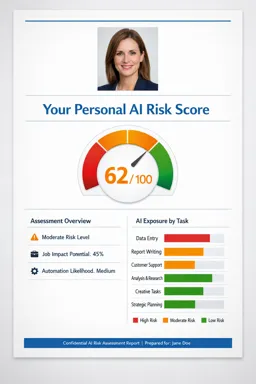
What's your AI risk score?
We're building a free tool that analyses your career against millions of data points and gives you a personal risk score with transition paths. We'll only build it if there's demand.
No spam. We'll only email you if we build it.
The AI-Proof Career Guide
We've found clear patterns in the data about what actually protects careers from disruption. We'll publish it free — but only if people want it.
No spam. We'll only email you if we write it.