Will AI Replace Industrial Engineering Jobs?
AI optimises production workflows, supply chains, and resource allocation — tasks at the core of industrial engineering. Engineers who redesign complex manufacturing systems, lead cross-functional process improvements, and manage organisational change retain value well beyond what optimisation tools deliver alone.
17 roles found
Battery Pack Test Engineer (Mid-Level)
Physical blast room work and HV safety requirements anchor this role in the real world, while AI transforms data analysis and reporting workflows. Safe for 5+ years as EV production scales.
Continuous Improvement Engineer (Mid-Level)
The analytical core of this role — data analysis, SPC, simulation, process mapping — is being automated by AI agents, process mining platforms, and digital twins. Plant floor observation, Kaizen facilitation, and cross-functional change leadership persist. Adapt within 2-5 years.
Digital Twins Engineer (Mid-Level)
Borderline Yellow at 47.5 — 0.5 points below Green. The role is growing fast but 45% of task time faces displacement from platform automation. Adapt within 3-5 years.
Ergonomics/Human Factors Engineer (Mid-Level)
This role's core work — on-site ergonomic assessments, cognitive task analysis, and human-system interface design — requires physical presence and professional judgment that AI cannot replicate. However, voluntary certification (BCPE), moderate barriers, and AI tools accelerating analytical sub-tasks place it below the Green threshold. Adapt within 3-7 years.
Health and Safety Engineer (Mid-Level)
This role is protected by mandatory physical site presence, PE/CSP licensing barriers, and personal liability for engineering safety decisions. AI transforms documentation and analytics but cannot replace the engineer inspecting facilities and designing safety systems. Safe for 5+ years.
Industrial Engineer (Mid-Level)
The analytical core of this role — data analysis, simulation, statistical process control — is being automated by AI agents and digital twin platforms. Plant floor observation, Kaizen facilitation, and cross-functional problem-solving persist. Adapt within 2-5 years.
Industrial Engineering Technologist/Technician (Mid-Level)
The execution-heavy core of this role — manual time studies, SPC data collection, production documentation — is being displaced by IoT sensors, AI-powered quality systems, and automated scheduling platforms. Equipment calibration and shop floor observation persist but cannot sustain the role alone. Act now.
Manufacturing Engineer (Mid-Level)
Physical shop floor presence -- troubleshooting machine breakdowns, validating tooling and fixtures, commissioning equipment, resolving quality escapes -- provides meaningful protection that desk-bound industrial engineers lack. But DFM review tools, AI-generated toolpaths, and process simulation are automating the analytical and design portions of the role. Adapt within 3-7 years.
Materials Engineer (Mid-Level)
AI-powered materials informatics platforms (Citrine, GNoME, Materials Project) are production-deployed and disrupting traditional experimental workflows more aggressively than in any other engineering discipline. Physical testing, failure analysis, and manufacturing integration persist — but 55% of task time faces meaningful AI augmentation or displacement. Adapt within 3-5 years.
Occupational Health and Safety Specialist (Mid-Level)
This role is protected by mandatory physical inspections, regulatory mandate, and professional certification barriers. AI transforms documentation and analytics but cannot replace the inspector on the factory floor. Safe for 5+ years.
Occupational Health and Safety Technician (Mid-Level)
AI-powered IoT sensors, wearables, and automated monitoring are displacing routine data collection tasks that form the technician's core workload. Physical sampling and field testing provide protection, but 45% of task time faces significant automation pressure. Adapt within 3-5 years.
Packaging Engineer (Mid-Level)
Structural packaging design and material optimisation are being accelerated by generative design tools and AI-driven simulation, but physical testing -- drop tests, compression tests, vibration tables, transit simulation -- requires lab presence and hands-on judgment that AI cannot replicate. Adapt within 2-5 years.
Paint Robot Programmer (Mid-Level)
Offline programming tools are automating path generation, but hazardous-environment booth access and spray validation keep humans essential for now. Adapt within 3-5 years.
Performance Engineer — Motorsport (Mid-Level)
Heavily AI-augmented role with 80% of task time at score 3+. Data analysis acceleration compresses headcount per team. Adapt within 3-5 years.
Precision Engineer (Mid-Level)
This role is protected by deep physical-world expertise and sub-micron judgment that AI cannot replicate, but AI CAM tools and automated metrology are transforming 30% of daily work. Safe for 5+ years with continued adaptation.
Quality Engineer (Mid-Level)
AI is automating the analytical and inspection-planning core of this role -- SPC, data analysis, automated visual inspection, and CAPA documentation -- while root cause analysis on the shop floor, supplier quality management, and audit leadership persist as human-led work. Adapt within 2-5 years.
Supply Chain Engineer (Mid-Level)
The analytical core of this role — network optimisation, inventory algorithms, logistics simulation — is being automated by OR solvers, digital twins, and ML forecasting platforms. Warehouse layout design and cross-functional coordination provide some protection. Adapt within 2-5 years.
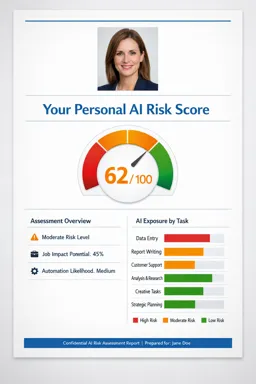
What's your AI risk score?
We're building a free tool that analyses your career against millions of data points and gives you a personal risk score with transition paths. We'll only build it if there's demand.
No spam. We'll only email you if we build it.
The AI-Proof Career Guide
We've found clear patterns in the data about what actually protects careers from disruption. We'll publish it free — but only if people want it.
No spam. We'll only email you if we write it.