Will AI Replace Environmental Engineering Jobs?
Environmental remediation, impact assessment, and sustainability design require field judgment, stakeholder engagement, and regulatory interpretation. AI helps model environmental systems and predict outcomes, but engineers who assess sites physically, design practical solutions, and navigate permitting stay essential.
17 roles found
Agricultural Engineer (Mid-Level)
Transforming now — AI is reshaping computational and analytical workflows while field work and PE-stamped design remain human-led. Adapt within 3-5 years by integrating precision agriculture and AI-driven design tools.
Air Quality Engineer (Mid-Level)
Air quality engineers are protected by Clean Air Act regulatory mandates, PE licensing for permit certification, and growing ESG/GHG reporting requirements, but 55% of task time faces meaningful AI augmentation as emissions modeling, inventory calculation, and reporting tools mature. Adapt within 3-7 years.
Battery Recycling Engineer (Mid-Level)
This role is protected by physical-chemical process complexity, hazardous environment requirements, and explosive sector growth driven by EV adoption and critical mineral policy. Safe for 5+ years, with significant daily workflow transformation as AI optimises process parameters.
Dismantling Engineer (Mid-Level)
This role is protected by strong structural barriers and growing demand from aging infrastructure and energy transition. Safe for 5+ years, but daily work is shifting as AI transforms planning and documentation tasks.
Environmental Engineer (Mid-Level)
Environmental regulations, field investigation requirements, and public health accountability protect the core of this role, but 65% of task time faces meaningful AI augmentation as environmental modeling, data analysis, and reporting tools mature. PE licensing is important for consulting and remediation sign-off but not universally required. Adapt within 3-7 years.
Environmental Engineering Technologist and Technician (Mid-Level)
This role faces significant automation pressure on its documentation, reporting, and laboratory analysis tasks while hands-on equipment operation and field sampling remain human-led. Adapt within 3-5 years by deepening equipment expertise and field capabilities.
Health and Safety Engineer (Mid-Level)
This role is protected by mandatory physical site presence, PE/CSP licensing barriers, and personal liability for engineering safety decisions. AI transforms documentation and analytics but cannot replace the engineer inspecting facilities and designing safety systems. Safe for 5+ years.
Mine Ventilation Officer (Mid-Level)
This role is protected by statutory appointment requirements, mandatory underground physical presence, and personal liability for atmospheric safety decisions affecting worker lives. AI transforms airflow modelling and gas data analysis but cannot replace the officer underground inspecting ventilation controls, interpreting gas readings in real time, and executing emergency ventilation protocols. Safe for 5+ years.
Mining and Geological Engineer, Including Mining Safety Engineer (Mid-Level)
This role is transforming as AI-powered mine planning, autonomous systems, and predictive analytics absorb design optimisation and documentation tasks — but physical mine presence, PE-stamped engineering judgment, and MSHA accountability anchor the core work to humans. Adapt within 2-5 years.
Nuclear Engineer (Mid-Level)
This role is protected by the most stringent regulatory framework in engineering (NRC), personal liability for nuclear safety decisions, and a nuclear renaissance driven by AI data center power demand and SMR development. AI transforms simulation speed and documentation but cannot replace the engineer accountable for reactor safety. Safe for 5+ years.
Occupational Health and Safety Specialist (Mid-Level)
This role is protected by mandatory physical inspections, regulatory mandate, and professional certification barriers. AI transforms documentation and analytics but cannot replace the inspector on the factory floor. Safe for 5+ years.
Occupational Health and Safety Technician (Mid-Level)
AI-powered IoT sensors, wearables, and automated monitoring are displacing routine data collection tasks that form the technician's core workload. Physical sampling and field testing provide protection, but 45% of task time faces significant automation pressure. Adapt within 3-5 years.
Remediation Engineer (Mid-Level)
Contaminated site cleanup demands physical field presence, CERCLA/RCRA regulatory accountability, and PE-stamped engineering judgment that AI cannot replicate -- but 55% of task time faces meaningful AI augmentation as environmental modeling, automated monitoring, and reporting tools mature. Adapt within 3-7 years.
Renewable Energy Engineer (Mid-Level)
AI-enhanced design, modelling, and simulation tools are transforming renewable energy engineering workflows, but strong market demand from the IRA, global Net Zero commitments, and the energy transition create a substantial demand buffer. 70% of task time faces meaningful AI augmentation or displacement. Adapt within 3-7 years.
Sustainability Engineer (Mid-Level)
ESG reporting, carbon accounting, and compliance documentation face significant AI displacement, but sustainability strategy, green design implementation, and stakeholder engagement require human judgment that protects the core. Regulatory tailwinds (CSRD, SEC climate disclosure) drive demand, but AI-automated ESG platforms compress headcount per project. Adapt within 3-7 years.
Waste Management Engineer (Mid-Level)
Landfill site inspections, construction quality assurance, RCRA Subtitle D regulatory accountability, and PE-stamped design submissions protect the field-intensive core of this role, but 55% of task time faces meaningful AI augmentation as landfill modeling, leachate prediction, and reporting tools mature. Adapt within 3-7 years.
Water/Wastewater Treatment Engineer (Mid-Level)
PE licensing, public health liability for drinking water and effluent quality, and mandatory field presence for pilot testing and plant commissioning protect this role. SCADA/IoT integration and AI-powered process optimization are reshaping daily workflows, but the physical-regulatory-judgment triad keeps the engineer irreplaceable. IIJA infrastructure investment and PFAS regulatory expansion sustain demand. Safe for 5+ years with adaptation.
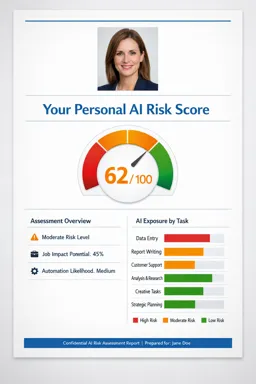
What's your AI risk score?
We're building a free tool that analyses your career against millions of data points and gives you a personal risk score with transition paths. We'll only build it if there's demand.
No spam. We'll only email you if we build it.
The AI-Proof Career Guide
We've found clear patterns in the data about what actually protects careers from disruption. We'll publish it free — but only if people want it.
No spam. We'll only email you if we write it.