Will AI Replace Diagnostic Imaging Jobs?
AI excels at pattern recognition in medical imaging, automating preliminary reads and flagging abnormalities with increasing accuracy. Radiologists and imaging technologists who interpret complex cases, correlate clinical context, and perform image-guided procedures evolve their practice alongside AI tools.
31 roles found
Cardiac Physiologist (Mid-Level)
UK HCPC-registered cardiac physiologists independently perform and report echocardiograms, ECGs, exercise tolerance tests, and pacemaker checks — diagnostic autonomy that anchors the role in the Green Zone despite AI-assisted interpretation tools entering production. Safe for 5+ years with significant workflow transformation ahead.
Cardiovascular Technologist and Technician (Mid-Level)
AI-powered ECG interpretation and echo analysis are production-ready and transforming 30% of this role's diagnostic tasks. The 40% of work time spent in cath labs and hands-on patient care provides strong physical protection, but average BLS growth (3-4%) and voluntary credentialing weaken the safety net. Adapt within 3-7 years.
Clinical Oncologist (Mid-to-Senior)
UK-specific dual-modality cancer specialist combining chemotherapy AND radiotherapy — protected by GMC registration, IR(ME)R radiation prescriber accountability, and the irreplaceable physician-patient relationship through cancer diagnosis, treatment, and end-of-life care. AI auto-contouring transforms radiotherapy planning workflows but cannot prescribe treatment or bear clinical liability. Safe for 10+ years.
Clinical Scientist — Neurophysiology (Mid-Level)
HCPC-protected title, hands-on neurophysiological testing, and clinical interpretation authority anchor this role firmly in the human domain. AI augments analysis but cannot acquire recordings or bear diagnostic accountability. Safe for 5+ years.
Diagnostic Medical Sonographer (Mid-Level)
Hands-on transducer manipulation, real-time patient adaptation, and ARDMS certification anchor this role firmly in the human domain. AI enhances measurement accuracy and workflow efficiency but cannot perform autonomous scanning. Safe for 5+ years.
Diagnostic Radiologic Technologist — MRI (Mid-Level)
Patient positioning, RF coil placement, ferromagnetic safety screening, and MRI scanner operation in a strong magnetic field environment cannot be automated. AI accelerates image reconstruction and optimises protocols but the hands-on technologist remains essential. Safe for 5+ years.
EEG Technologist / Neurodiagnostic Technologist (Mid-Level)
Physical electrode placement, intraoperative neuromonitoring, and ABRET credentialing anchor this role in the human domain. AI reads recordings but cannot acquire them. Safe for 5+ years.
Gastrointestinal Physiologist (Mid-Level)
UK HCPC-registered GI physiologists independently perform and report oesophageal manometry, pH-impedance monitoring, anorectal physiology, and breath tests — hands-on diagnostic procedures with independent clinical reporting authority that anchor the role in the Green Zone despite early-stage AI pattern recognition entering the manometry workflow. Safe for 5+ years with meaningful workflow transformation ahead.
Health Technologists and Technicians, All Other (Mid-Level)
This BLS catch-all covers hands-on health techs — dialysis, ophthalmic, audiometric, orthotics — performing patient procedures under physician supervision. Physical patient contact protects, but automated diagnostics and AI-enhanced monitoring are steadily absorbing routine technical tasks. Adapt and specialise within 3-5 years.
Interventional Radiologist (Mid-to-Senior)
Interventional radiologists are hands-in-the-body proceduralists who thread catheters through arteries, place stents under live fluoroscopy, ablate tumours, and stop haemorrhage in real time. AI is transforming diagnostic radiology's image-reading pipeline but has barely touched the irreducible physical core of IR: navigating guidewires through tortuous vasculature, managing complications on the table, and making split-second decisions when a vessel perforates. Safe for 15+ years.
Magnetic Resonance Imaging Technologist (Mid-Level)
MRI technologists operate in a strong magnetic field environment where hands-on patient positioning, coil placement, and ferromagnetic safety screening cannot be automated. AI enhances image reconstruction and workflow efficiency but the operator remains essential. Safe for 5+ years.
Mammographer (Mid-Level)
Intimate physical breast positioning and compression, MQSA federal personnel mandates, and strong cultural barriers to non-human intimate examination anchor this role firmly in the human domain. AI transforms image reading (radiologist work) not image acquisition (mammographer work). Safe for 5+ years.
Medical Dosimetrist (Mid-Level)
AI auto-planning and auto-contouring tools are transforming 75% of this role's daily workflow. The desk-based, computational core of dosimetry is precisely what AI targets in radiation oncology. Strong licensing and physician oversight mandates prevent displacement but cannot prevent workforce compression. Adapt within 2-5 years.
Medical Physicist — Diagnostic Imaging (Senior)
This role's combination of radiation safety accountability, regulatory authority, and hands-on equipment work creates strong structural protection. AI augments dose optimisation and QA analysis but cannot bear the legal and professional liability that defines the senior diagnostic imaging physicist. Safe for 5+ years, with significant daily workflow transformation underway.
Neurodiagnostic Technologist (Mid-Level)
Electrode placement, needle EMG, intraoperative neuromonitoring, and ABRET credentialing anchor this role in the physical domain. AI reads recordings but cannot acquire them. Safe for 5+ years with growing surgical demand.
Neuroradiologist (Mid-to-Senior)
Neuroradiology is the most AI-exposed radiology subspecialty -- Viz.ai stroke detection deployed in 1,400+ hospitals, brain volumetric quantification tools in production, and deep learning algorithms matching human performance on specific neuroimaging tasks. Yet zero neuroradiologists have been displaced. Complex clinical correlation, neuro-interventional procedures, and physician liability protect the role while AI transforms 55% of daily workflow. Safe for 10+ years; daily work changing rapidly.
Nuclear Medicine Physician (Mid-to-Senior)
This role is expanding with theranostics growth. AI augments imaging interpretation and dosimetry but cannot prescribe or administer radioactive treatments. Protected for 5+ years with significant daily workflow transformation.
Nuclear Medicine Technologist (Mid-Level)
Hands-on radiopharmaceutical preparation, intravenous injection, patient positioning, and radioactive materials handling anchor this role firmly in the human domain. AI enhances image reconstruction and workflow but cannot replace the technologist at the camera. Safe for 5+ years.
Ophthalmic Medical Technician (Mid-Level)
AI-powered diagnostic screening tools are production-ready and automating core testing workflows. The physical patient care and equipment operation preserve the role for now, but 60% of task time faces significant AI augmentation or displacement within 3-5 years.
Ophthalmic Photographer (Mid-Level)
Hands-on camera operation, patient positioning, and specialised retinal imaging techniques protect this role from displacement. AI autonomous screening tools (IDx-DR, EyeArt) handle routine diabetic retinopathy detection but cannot perform the physical act of capturing complex diagnostic images. Safe for 5+ years with specialisation.
Ophthalmic Technician (Mid-Level)
AI-powered diagnostic screening and imaging analysis tools are production-ready, automating core testing workflows. Physical patient care and equipment operation preserve the role for now, but 60% of task time faces significant AI augmentation or displacement within 3-5 years.
Optometrist (Mid-to-Senior)
Core work is face-to-face eye examinations, physical assessments, and prescriptive authority that AI cannot perform. AI is transforming diagnostic imaging analysis (retinal scans, OCT, visual fields) but the optometrist's clinical judgment, patient relationship, and hands-on examination remain irreplaceable. Safe for 15+ years; daily workflow shifting.
Orthoptist (Mid-Level)
Core work is face-to-face clinical assessment and treatment of eye movement disorders and binocular vision problems — hands-on, patient-facing work that AI cannot perform. AI strabismus screening tools remain in research; no production deployment threatens orthoptic practice. Safe for 15+ years; daily workflow largely unchanged.
PACS Administrator (Mid-Level)
Cloud PACS migration and vendor-managed SaaS models are absorbing on-premise server administration, while AI workflow orchestration automates DICOM routing and image lifecycle management. The role's HIPAA-regulated environment, clinical integration complexity, and interoperability troubleshooting provide moderate protection, but the infrastructure management core is eroding toward vendor platforms. Adapt within 3-5 years.
Page 1 of 2
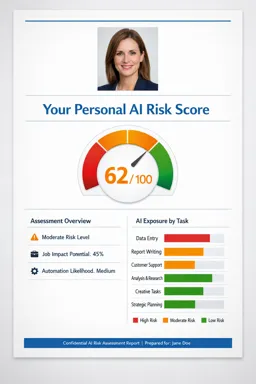
What's your AI risk score?
We're building a free tool that analyses your career against millions of data points and gives you a personal risk score with transition paths. We'll only build it if there's demand.
No spam. We'll only email you if we build it.
The AI-Proof Career Guide
We've found clear patterns in the data about what actually protects careers from disruption. We'll publish it free — but only if people want it.
No spam. We'll only email you if we write it.