Jobs That AI Cannot Replace [September 2026]
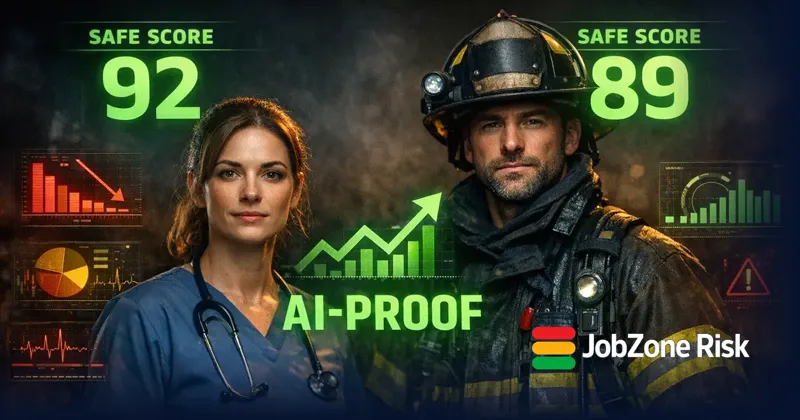
Jobs that AI cannot replace share three traits: they require a human body in the room, a licence to practise, or a trust relationship that people won’t accept from a machine. 🇺🇸 56.2M US workers — 33% of the assessed workforce — are in GREEN zone roles. We scored 3649 roles against real AI capabilities; 200 (5%) land in the GREEN zone.
These aren’t niche outliers. Healthcare, skilled trades, education, cybersecurity, and engineering dominate the list. Many face critical worker shortages. Below we show you the safest roles, what makes them safe, and which industries offer the strongest protection — backed by 136+ externally-sourced statistics from the WHO, BLS, ISC2, UNESCO, ManpowerGroup, Korn Ferry, IRENA, IET, and more.
We also cover the salary data (GREEN zone roles consistently pay 20-40% above the national median), the global shortage picture (every developed economy faces the same gaps), the historical evidence (these roles survived every previous automation wave), and practical reskilling pathways if you want to move into a protected career.
🏆 Top 20 Jobs AI Cannot Replace
These are the 20 highest-scoring roles in our database. Every one of them combines multiple structural barriers that AI cannot overcome. Physical presence, licensing, trust, and real-time judgement create layers of protection no amount of AI capability can erode.
The pattern is consistent: physical presence (surgeons, electricians, firefighters), regulatory licensing (doctors, nurses, pilots), and trust relationships (therapists, teachers, social workers). Most top-20 roles have all three. The average score across the top 20 is well above 70 — deep in GREEN zone territory, with multiple reinforcing barriers.
GREEN Zone Profile
- • Location: Must be physically present
- • Regulation: Licensed or certified
- • Tasks: Variable, contextual, judgement-based
- • Human element: Trust, empathy, physical skill IS the service
- • Demand trend: Growing — persistent shortages
- • Salary trend: Above-average and rising
RED Zone Profile (for contrast)
- • Location: Entirely screen-based
- • Regulation: No licensing required
- • Tasks: Repeatable, pattern-matching, rule-following
- • Human element: Output is data, text, or process
- • Demand trend: Shrinking as AI takes over tasks
- • Salary trend: Under pressure from automation
The contrast is instructive. Every trait that makes a role AI-resistant — physical presence, licensing, trust, variable conditions — is also a trait that makes it harder to fill. That’s why the GREEN zone roles face persistent shortages: the same barriers that block AI also limit the supply of qualified humans. For workers, this is the best possible position: protected from automation AND in high demand.
🛡️ What Makes These Jobs AI-Resistant?
The GREEN zone roles share four protective traits that current AI systems cannot replicate. Roles with all four score highest. Roles with none score lowest. The correlation between barrier count and AI resistance is near-perfect.
Physical Presence Required
Roles that require hands-on physical work — wiring, lifting, patient care, site inspection — cannot be performed by software. The body is the barrier. A plumber needs hands. A surgeon needs to be in the operating room. No API call replaces that.
Regulatory Licensing
Licensed professions have legal frameworks that prevent AI from practising independently, regardless of capability. No jurisdiction licenses an AI to prescribe medication, sign off on electrical work, or fly a commercial aircraft. Regulatory change moves at legislative speed — years to decades.
Human Judgement Under Uncertainty
Roles requiring real-time decisions in unpredictable, high-stakes environments demand contextual reasoning AI cannot match. A firefighter assessing a collapsing building. A detective reading a suspect. A paramedic triaging multiple casualties. These aren’t pattern-matching problems — they’re judgement calls in chaos.
Interpersonal Trust
Roles built on human connection — counselling, teaching, case management, pastoral care — depend on the relationship itself. The human IS the service. People won’t accept AI therapy, AI teaching their children, or AI delivering a terminal diagnosis. Trust is the barrier AI cannot fake.
How Barriers Stack
Roles with one barrier have moderate protection. Roles with two barriers are strongly protected. Roles with three or four are effectively immune to AI displacement on any foreseeable timeline. Most GREEN zone roles have at least two. The top 20 have three or four.
Why can’t AI replicate these traits? Physical presence is a hardware problem: even the most advanced robots can’t match human dexterity in variable environments (a pipe in a different position every time, a patient in a different condition every time). Licensing is a legal problem: legislatures move in years, not months, and no electorate will vote to let AI practise medicine unsupervised. Trust is a psychological problem: humans form relationships with other humans — a therapist’s effectiveness depends on the patient believing they’re heard by a person.
These barriers aren’t temporary limitations that will be solved with better models. They’re structural — rooted in physics (bodies in space), law (regulatory frameworks), and human psychology (trust and empathy). An LLM that’s 10x more capable still can’t wire a house. An AI agent that’s 100x more capable still can’t legally prescribe medication. The barriers are not about AI intelligence — they’re about what a digital system fundamentally cannot do.
🤖 What AI Can and Cannot Do (Today)
Understanding which jobs AI cannot replace requires understanding what AI actually does well and where it fundamentally fails. The gap between AI capability and human capability is not closing uniformly — it’s closing fast in some areas and not at all in others.
What AI Does Well
- • Pattern matching — Recognising patterns in text, images, data
- • Text generation — Writing, summarising, translating standard content
- • Code generation — Writing routine code from specifications
- • Data processing — Sorting, filtering, extracting from structured data
- • Prediction — Forecasting from historical data patterns
- • Classification — Categorising items into predefined groups
- • Optimisation — Finding best solutions within defined constraints
Roles built primarily on these tasks face displacement pressure.
What AI Cannot Do
- • Physical manipulation — Handling objects in variable real-world environments
- • Genuine empathy — Understanding human emotions through lived experience
- • Legal authority — Holding a licence, signing legally binding documents
- • Moral reasoning — Making ethical judgements with real consequences
- • Novel creativity — Creating genuinely new ideas (not recombining existing ones)
- • Trust building — Forming human relationships that require authenticity
- • Chaos navigation — Making decisions in truly unpredictable situations
Roles built primarily on these capabilities are structurally protected.
The key insight: AI’s capabilities are improving rapidly within the “can do” column. But the “cannot do” column is not about AI intelligence — it’s about what a digital system fundamentally is. An LLM that’s 1,000x more capable still has no hands, no licence, no legal standing, and no genuine emotional experience. These are not limitations that will be “solved” with better models. They’re boundaries between what software is and what a human body and mind are.
The Implication for Your Career
If your job is primarily in the left column (pattern matching, text generation, data processing), AI is a direct competitor. If it’s primarily in the right column (physical work, legal authority, human trust), AI is a tool that makes you more productive. The most protected careers combine multiple right-column elements. The most exposed combine multiple left-column elements. Most jobs are a mix — which is why YELLOW zone roles (augmentation, not replacement) are the largest category in our database.
🏭 AI Resistance by Industry
AI resistance varies dramatically by sector. Healthcare, trades, education, and cybersecurity dominate the GREEN zone. Finance and administration sit at the other end. The domain scores below show the structural protection level for each industry.
| Domain | Avg JobZone Score |
|---|---|
| Trades & Physical | 60.5 |
| Veterinary & Animal Care | 59.8 |
| Military | 57.6 |
| Healthcare | 57.5 |
| Sports & Recreation | 56.2 |
| AI | 56.0 |
| Social Services | 55.8 |
| Religious & Community | 54.4 |
| Public Safety | 53.0 |
| Utilities & Energy | 50.6 |
| Other | 50.5 |
| Education | 49.1 |
| Cybersecurity | 49.0 |
| Agriculture | 48.1 |
| Transportation | 46.4 |
| Engineering | 46.0 |
| Government & Public Admin | 42.4 |
| Retail & Service | 40.8 |
| Science & Research | 40.7 |
| Legal & Compliance | 39.7 |
| Library, Museum & Archives | 39.4 |
| Creative & Media | 37.2 |
| Development | 36.0 |
| Cloud & Infrastructure | 35.1 |
| Real Estate & Property | 34.5 |
| Manufacturing | 31.1 |
| Business & Operations | 29.6 |
| Data | 28.6 |
The domain scores above reveal a structural divide. Industries built on physical work, licensing, and human relationships cluster at the top. Industries built on digital, pattern-based work cluster at the bottom. The gap between the highest-scoring and lowest-scoring domains is substantial — and it maps directly to the four protective traits identified earlier.
How to Read the Domain Scores
Higher scores = stronger structural protection from AI. Domains scoring above 55 are dominated by GREEN zone roles. Domains scoring below 40 have significant RED zone exposure. The scores reflect the average across all assessed roles in that domain — individual roles within a domain can vary widely. Use the domain score as a directional indicator, then check specific roles for precise scores.
🏥 Healthcare & Nursing
Healthcare is the single most AI-resistant major sector. The WHO projects a 10 million health worker shortage by 2030 — demand is growing faster than AI can augment, let alone replace. Nurse practitioners, registered nurses, surgeons, and therapists all sit firmly in the GREEN zone. The combination of physical examination, licensing, and patient trust makes these roles structurally irreplaceable.
JobZone Data: Healthcare
379 roles assessed · 78% in GREEN zone
| # | Role | Zone | Score |
|---|---|---|---|
| 1 | Trauma Surgeon (Mid-to-Senior) | GREEN | 83.2 |
| 2 | Registered Nurse (Clinical/Bedside) | GREEN | 82.2 |
| 3 | Complex Family Planning Specialist (Mid-to-Senior) | GREEN | 82.0 |
| 4 | Forensic Pathologist (Mid-to-Senior) | GREEN | 81.7 |
| 5 | ICU Nurse (Mid-Level) | GREEN | 81.2 |
| 6 | Electrophysiologist — Cardiac (Mid-to-Senior) | GREEN | 80.7 |
| 7 | Interventional Cardiologist (Mid-to-Senior) | GREEN | 80.7 |
| 8 | Hospice Nurse (Mid-Level) | GREEN | 80.6 |
| 9 | Labor and Delivery Nurse (Mid-Level) | GREEN | 80.2 |
| 10 | Approved Mental Health Professional (AMHP) (Mid-Level) | GREEN | 79.9 |
| Finding | Value | Source |
|---|---|---|
| Global health worker shortage by 2030 (WHO) | 10M | WHO Global Strategy on Human Resources for Health |
| Nurse practitioner projected growth (US) | +45% | BLS Occupational Outlook Handbook |
| Registered nurses employed (US) | 3,175,390 | BLS Occupational Outlook Handbook |
| Home health aide new jobs projected (US) | 819,500 | BLS Occupational Outlook Handbook |
| Healthcare sector projected growth (US) | +12% | BLS Occupational Outlook Handbook |
| NHS vacancies (UK) | 107,000 | NHS Vacancy Statistics England |
| Median healthcare practitioner wage (US) | $77,860 | BLS Occupational Outlook Handbook |
| US physician shortage projected by 2034 | 86,000 | AAMC |
| Mental health counsellor growth (US) | +19% | BLS Occupational Outlook Handbook |
| Nurse practitioner median wage (US) | $126,260 | BLS Occupational Outlook Handbook |
| Global nursing shortage (WHO) | 5.9M | WHO State of the World's Nursing 2024 |
| Physician assistant growth (US) | +28% | BLS Occupational Outlook Handbook |
| Physical therapist growth (US) | +14% | BLS Occupational Outlook Handbook |
| Respiratory therapist growth (US) | +13% | BLS Occupational Outlook Handbook |
| Epidemiologist growth (US) | +23% | BLS Occupational Outlook Handbook |
| NHS nursing vacancies (UK) | 34,260 | NHS Vacancy Statistics England |
| Adult social care vacancies (UK) | 152,000 | Skills for Care State of the Workforce 2024 |
| Health professional shortage areas (US) | 8,100+ | HRSA |
| Aged care worker gap (Australia) | 110,000 | Jobs and Skills Australia / Royal Commission |
The stats table above tells the demand story in numbers. Every BLS projection for healthcare shows growth. Every WHO report shows shortage. AI tools assist with diagnostics, record-keeping, and scheduling — but the licensed practitioner at the bedside remains the irreplaceable element.
Why Healthcare Demand Keeps Growing
Three forces drive healthcare demand simultaneously: ageing populations (the baby boomer generation is entering peak healthcare consumption), expanding access (more people with insurance and care pathways), and rising chronic disease (obesity, diabetes, mental health). None of these are solved by AI. Each requires more human hands, more licensed practitioners, and more trusted relationships. The WHO's 10M worker gap is a conservative estimate.
The shortage data from six countries tells the same story. The AAMC projects a US physician shortage in the tens of thousands by 2034. The NHS has six-figure vacancies. Australia’s aged care sector faces a workforce gap that widens every year. In every country, for every healthcare role, the story is the same: not enough humans, and AI cannot fill the gap.
AI is transforming healthcare workflows — diagnostic imaging, drug discovery, patient scheduling, medical records. But every one of these AI applications makes clinicians more effective, not redundant. A radiologist using AI reads scans faster and more accurately. A nurse using AI patient management spends less time on paperwork and more time at the bedside. AI in healthcare is the clearest example of augmentation, not replacement. The technology amplifies human capability without substituting for human presence.
The mental health sector deserves special attention. BLS projects 19% growth for mental health counsellors. The WHO reports a global mental health workforce crisis. Demand is driven by rising awareness, reduced stigma, and pandemic-era trauma. AI chatbots exist for mental health support, but research consistently shows the therapeutic alliance — the relationship between therapist and client — is the strongest predictor of treatment outcomes. A human therapist isn’t just preferred — they’re clinically more effective.
🔧 Trades & Construction
Skilled trades are the most structurally protected occupation group in the modern economy. AI cannot wire a house, fix a pipe, or pour concrete — and there is no timeline where it can. The AGC reports 91% of US construction firms struggle to fill positions. These roles require physical presence, licensing, and hands-on dexterity — the exact combination that makes them immune to AI displacement.
| Finding | Value | Source |
|---|---|---|
| US construction firms struggling to fill positions | 91% | AGC Workforce Survey 2024 |
| Electrician projected growth (US) | +11% | BLS Occupational Outlook Handbook |
| Plumber projected growth (US) | +6% | BLS Occupational Outlook Handbook |
| HVAC technician projected growth (US) | +9% | BLS Occupational Outlook Handbook |
| Wind turbine technician projected growth (US) | +60% | BLS Occupational Outlook Handbook |
| Solar installer projected growth (US) | +48% | BLS Occupational Outlook Handbook |
| US infrastructure spending (IIJA) | $1.2T | White House IIJA Fact Sheet |
| UK construction workers needed (CITB) | 225,000 | CITB Construction Skills Network |
| Electrician median wage (US) | $61,590 | BLS Occupational Outlook Handbook |
| Plumber median wage (US) | $61,550 | BLS Occupational Outlook Handbook |
| Construction manager median wage (US) | $104,900 | BLS Occupational Outlook Handbook |
| Welder projected growth (US) | +2% | BLS Occupational Outlook Handbook |
| Carpenter projected growth (US) | +2% | BLS Occupational Outlook Handbook |
| Industrial machinery mechanic growth (US) | +16% | BLS Occupational Outlook Handbook |
| Craft worker shortage (US, NCCER) | 501,000 | ABC / NCCER |
| US construction spending (annual) | $2.1T | US Census Bureau Construction Spending |
| Skilled trades vacancies (Germany) | 143,000 | ZDH / Bundesagentur für Arbeit |
| Construction vacancies (Germany) | 45,000 | Bundesagentur für Arbeit |
The trades are the clearest example of structural AI resistance. Every role requires physical presence on a job site. Most require professional licensing or certification. The work is variable — no two wiring jobs, plumbing repairs, or construction sites are identical. Infrastructure spending ($1.2T from the IIJA alone) is adding demand on top of existing shortfalls. These roles don’t just survive AI — they thrive alongside it.
The Infrastructure Boom
The $1.2 trillion Infrastructure Investment and Jobs Act is the largest US infrastructure programme in decades. It funds roads, bridges, broadband, electric grid modernisation, and clean energy construction. Every dollar requires human tradespeople to build. On top of this, the clean energy transition needs electricians for EV chargers, HVAC technicians for heat pumps, and construction crews for solar and wind farms. Demand is accelerating on top of existing shortages.
The trades also have a demographic crisis: the average construction worker is ageing out. The AGC reports that recruitment of younger workers isn't keeping pace with retirements. This creates a double demand signal: replacement of retiring workers PLUS new demand from infrastructure spending. For anyone entering the trades now, the supply-demand dynamics are the most favourable they’ve been in a generation.
The trades also demonstrate why AI resistance is not about intelligence or education level. An electrician’s work requires deep technical knowledge (national electrical codes, circuit design, load calculations), practical skill (pulling wire through walls, terminating connections in tight spaces), and professional judgement (diagnosing faults, ensuring safety in live environments). The stereotype that trades are “unskilled” is objectively false — and the salary data proves it. A master electrician with 10 years of experience can earn over $80,000, with zero student debt.
Construction technology is advancing rapidly — 3D printing, drone surveys, BIM modelling, IoT sensors — but every advancement creates demand for the humans who operate, maintain, and oversee these systems on job sites. A 3D-printed wall still needs an electrician to wire it. A drone survey still needs an engineer to interpret it. The technology makes the work more sophisticated, not less human-dependent. This is the historical pattern repeating in real time.
The Trades Opportunity
For career changers, the trades offer a uniquely attractive combination: no degree required (apprenticeships pay from day one), above-median wages within 4-5 years, near-zero AI displacement risk, persistent shortage-driven demand, and the satisfaction of tangible, physical work. The stigma against trades careers is the single biggest market inefficiency in the labour market — and it works in favour of anyone willing to ignore it.
🎓 Education & Teaching
Teaching requires physical classroom presence, trust relationships with students and parents, and real-time judgement in unpredictable environments. UNESCO estimates the world needs 44 million additional teachers by 2030. AI tools help teachers work more efficiently, but they don’t replace the human in the room.
JobZone Data: Education & Teaching
146 roles assessed · 57% in GREEN zone
| # | Role | Zone | Score |
|---|---|---|---|
| 1 | Special Education Teacher, Kindergarten and Elementary School (Mid-Level) | GREEN | 75.1 |
| 2 | School Midday Supervisor / Lunchtime Supervisor (Mid-Level) | GREEN | 74.9 |
| 3 | Sign Language Interpreter (Mid-Level) | GREEN | 73.0 |
| 4 | SEN Teacher (Mid-Level) | GREEN | 71.3 |
| 5 | Special Education Teacher, Middle School (Mid-Level) | GREEN | 71.3 |
| 6 | Health Specialties Teacher, Postsecondary (Mid-Level) | GREEN | 70.9 |
| 7 | Instructor of Persons with Disabilities (Mid-Level) | GREEN | 70.0 |
| 8 | Vice-Chancellor (Senior/Executive) | GREEN | 70.0 |
| 9 | Forest School Leader (Mid-Level) | GREEN | 70.0 |
| 10 | Nursing Instructor, Postsecondary (Mid-Level) | GREEN | 70.0 |
| Finding | Value | Source |
|---|---|---|
| Additional teachers needed globally by 2030 (Global) | 44M | UNESCO Institute for Statistics |
| US states reporting teacher shortages | 47 states | NCES Teacher Shortage Areas |
| Teacher pay penalty vs comparable workers (US) | -23.5% | Economic Policy Institute |
| Postsecondary teacher growth (US) | +8% | BLS Occupational Outlook Handbook |
| Special education teacher growth (US) | +4% | BLS Occupational Outlook Handbook |
| UK secondary teacher recruitment vs target | 69% | DfE Initial Teacher Training Census |
| High school teacher median wage (US) | $65,230 | BLS Occupational Outlook Handbook |
| Annual teacher turnover rate (US) | 8% | NCES Teacher Attrition & Mobility |
| Instructional coordinator growth (US) | +2% | BLS Occupational Outlook Handbook |
| School counsellor growth (US) | +4% | BLS Occupational Outlook Handbook |
| Training specialist growth (US) | +6% | BLS Occupational Outlook Handbook |
| Teacher salary vs national avg (OECD) | 90% | OECD Education at a Glance 2024 |
| Self-enrichment teacher growth (US) | +11% | BLS Occupational Outlook Handbook |
Teaching requires physical classroom presence, real-time adaptation to student needs, and trust relationships with children and families. UNESCO estimates 44 million additional teachers needed by 2030. The US alone has teacher shortages in 47 states. AI tools assist with lesson planning and grading but cannot replace the teacher in the room — and parents won’t accept it.
The Teacher Pay Paradox
EPI data shows teachers earn 23.5% less than comparable college-educated workers — the largest pay penalty on record. Yet the shortage is at crisis levels in 47 states. This creates an unusual dynamic: AI can't replace teachers, shortages are critical, but pay hasn't risen enough to attract sufficient supply. The result is one of the most structurally protected yet undercompensated sectors in the economy. For workers who value job security over maximum salary, education offers near-absolute AI protection.
The education sector also highlights a critical point about AI augmentation vs replacement. AI tools are transforming how teachers work — automated grading, personalised learning platforms, AI-generated lesson plan suggestions. But none of these replace the teacher. They make the teacher more effective. A teacher using AI grading tools can spend more time on one-to-one student interaction, which is the part of the job that matters most and that AI cannot do. This is the augmentation model at its clearest: AI handles the routine, the human handles the relationship.
Special education is the strongest example within teaching. SPED teachers work with students who have unique, unpredictable needs requiring moment-to-moment professional judgement, physical assistance, and deep trust relationships with students and families. 45 US states report SPED as a shortage area. AI cannot observe a child’s non-verbal cues, adjust a lesson in real-time, or build the trust a non-verbal student needs to engage. This is irreplaceable work.
🔒 Cybersecurity
Cybersecurity is the paradox sector: AI creates more security jobs, not fewer. Every AI system deployed creates new attack surface. ISC2 reports a global workforce gap of 4.8 million. BLS projects 33% growth for information security analysts through 2033 — six times the national average. This sector grows in direct proportion to AI adoption elsewhere.
JobZone Data: Cybersecurity
91 roles assessed · 56% in GREEN zone
| # | Role | Zone | Score |
|---|---|---|---|
| 1 | AI Safety Researcher (Mid-Senior) | GREEN | 85.2 |
| 2 | Chief Information Security Officer (CISO) (Senior/Executive) | GREEN | 83.0 |
| 3 | AI Security Engineer (Mid-Level) | GREEN | 79.3 |
| 4 | OT/ICS Security Engineer (Mid-Level) | GREEN | 73.3 |
| 5 | AI Governance Lead (Mid-Level) | GREEN | 72.3 |
| 6 | Enterprise Security Architect (Principal) | GREEN | 71.1 |
| 7 | Chief Privacy Officer (Executive/C-Suite) | GREEN | 70.6 |
| 8 | AI/ML Engineer — Cybersecurity (Mid-Level) | GREEN | 69.2 |
| 9 | Senior Security Architect (Senior) | GREEN | 67.8 |
| 10 | Cyber Security Architect (Senior) | GREEN | 66.8 |
| Finding | Value | Source |
|---|---|---|
| Global cybersecurity workforce gap | 4.8M | ISC2 Cybersecurity Workforce Study 2024 |
| Total cybersecurity workforce (Global) | 5.5M | ISC2 Cybersecurity Workforce Study 2024 |
| Info security analyst projected growth (US) | +33% | BLS Occupational Outlook Handbook |
| Info security analyst median wage (US) | $120,360 | BLS Occupational Outlook Handbook |
| Global cybercrime annual cost | $10.5T | Cybersecurity Ventures |
| Orgs attributing breaches to skills gap (Global) | 87% | Fortinet Cybersecurity Skills Gap Report 2024 |
| Global security spending | $212B | Gartner |
| Cybersecurity salary premium vs general IT (Global) | +16% | ISC2 Cybersecurity Workforce Study 2024 |
| Orgs with unfilled cyber positions (Global, ISACA) | 62% | ISACA State of Cybersecurity 2024 |
| Cybersecurity supply/demand ratio (US) | 68 workers per 100 jobs | CyberSeek |
| Annual cybersecurity openings (US) | 17,300 | BLS Occupational Outlook Handbook |
| UK cybersecurity vacancies | 14,000+ | DSIT Cyber Security Skills in the UK Labour Market |
| Cybersecurity professionals (India) | 350,000 | NASSCOM / DSCI Report |
The cybersecurity data points in a single direction. Every metric — workforce gap, growth rate, salary premium, breach cost — shows a sector where human demand is accelerating, not contracting. The regulatory tailwind from GDPR, the EU AI Act, and NIS2 adds further demand for compliance-trained security professionals.
The AI-Cybersecurity Feedback Loop
Every AI system deployed creates new attack surface. Every automated process introduces new vulnerability. AI-generated code has security flaws that need human review. AI-powered phishing is more convincing, requiring more sophisticated human defenders. The cybersecurity sector doesn't just resist AI — it grows because of AI. ISC2 reports the workforce gap is widening, not closing. The supply/demand ratio in the US is just 68 workers per 100 open positions.
Cybersecurity also benefits from the regulatory tailwind. GDPR, the EU AI Act, NIS2, and expanding US compliance requirements all mandate security practices that require human oversight. As regulation increases, so does demand for compliance-trained security professionals. The combination of expanding attack surface, regulatory requirements, and criminal innovation makes cybersecurity the one sector where AI adoption directly increases human employment.
⚙️ Engineering
Engineering combines advanced education, professional licensing, and physical-world application. Civil engineers visit sites. Electrical engineers work on live systems. Environmental engineers assess real terrain. The IET reports the UK alone needs 124,000 additional engineers and technicians annually. AI augments the design process but cannot replace the licensed professional in the field.
JobZone Data: Engineering
194 roles assessed · 51% in GREEN zone
| # | Role | Zone | Score |
|---|---|---|---|
| 1 | Reservoir Panel Engineer (Senior) | GREEN | 78.1 |
| 2 | Railway Signalling Engineer (Mid-Level) | GREEN | 76.1 |
| 3 | Launch Pad Technician (Mid-Level) | GREEN | 68.9 |
| 4 | Railway Electrification Engineer (Mid-Level) | GREEN | 67.3 |
| 5 | Platform Lift Service Engineer (Mid-Level) | GREEN | 65.6 |
| 6 | Ride Systems Engineer (Mid-Level) | GREEN | 64.4 |
| 7 | Field Service Engineer (Mid-Level) | GREEN | 62.9 |
| 8 | Dismantling Engineer (Mid-Level) | GREEN | 62.5 |
| 9 | ERTMS Systems Engineer (Mid-Level) | GREEN | 62.0 |
| 10 | Surveyor (Mid-to-Senior) | GREEN | 61.8 |
| Finding | Value | Source |
|---|---|---|
| UK annual engineering talent need | 124,000 | IET Skills & Demand in Industry Survey |
| Civil engineer projected growth (US) | +5% | BLS Occupational Outlook Handbook |
| Electrical engineer projected growth (US) | +5% | BLS Occupational Outlook Handbook |
| Industrial engineer projected growth (US) | +12% | BLS Occupational Outlook Handbook |
| Median engineer wage (US, all disciplines) | $97,970 | BLS Occupational Outlook Handbook |
| Environmental engineer growth (US) | +6% | BLS Occupational Outlook Handbook |
| Biomedical engineer growth (US) | +5% | BLS Occupational Outlook Handbook |
| Chemical engineer growth (US) | +8% | BLS Occupational Outlook Handbook |
| Aerospace engineer growth (US) | +6% | BLS Occupational Outlook Handbook |
| Computer hardware engineer growth (US) | +7% | BLS Occupational Outlook Handbook |
| Engineering vacancies (Germany) | 56,000 | Bundesagentur für Arbeit |
| Engineering shortage (Australia) | 26 specialisms | Engineers Australia / Jobs & Skills Australia |
| Engineering degrees awarded (US) | 130,000+ | ASEE Engineering by the Numbers |
Engineering combines advanced education, professional licensing, and physical-world application. AI augments the design process (CAD, simulation, optimisation) but cannot replace the licensed engineer who signs off on the bridge design, inspects the wiring, or assesses the environmental impact on-site. The median engineer wage is well above the national average, reflecting both skill scarcity and structural demand.
Engineering + AI = Augmentation, Not Replacement
AI is transforming engineering design — generative design, simulation, optimisation — but it cannot replace the licensed engineer who inspects the bridge, signs off the building plans, or assesses structural integrity on-site. The pattern is augmentation: AI makes engineers more productive (faster design iterations, better simulations) while the human retains responsibility for real-world decisions. Engineering employment grows because AI enables more ambitious projects, not because fewer engineers are needed.
The semiconductor reshoring trend is adding another demand layer. As countries build domestic chip fabrication capacity (CHIPS Act in the US, similar programmes in EU and Asia), demand for electrical, chemical, and industrial engineers is surging. Infrastructure electrification (EV charging, grid modernisation, heat pump adoption) adds further demand for electrical engineers specifically. The IET reports 124,000 engineers and technicians needed annually in the UK alone — a gap that has been widening for a decade.
🚑 Other AI-Resistant Sectors
Beyond the five major sectors above, several other occupation groups score consistently in the GREEN zone. Transportation and public safety stand out as large employment categories where physical presence, licensing, and real-time judgement create strong AI barriers.
Transportation
Commercial pilots, truck drivers, bus drivers, and maritime crew all require physical presence in a moving vehicle, professional licensing, and real-time decision-making in unpredictable conditions. The ATA reports a US truck driver shortage of 78,000+. Boeing projects 660,000 new pilots needed globally through 2044.
Autonomous vehicles are often cited as a threat, but current AV capabilities are narrow (good weather, mapped routes, no edge cases). Full autonomy in all conditions remains a decade+ away for trucks and longer for aviation. Regulatory approval adds further delay.
Public Safety
Police officers, firefighters, paramedics, and correctional officers operate in unpredictable, high-stakes, physical environments where split-second human judgement is literally life-or-death. AI can assist with dispatch, surveillance, and data analysis, but the responder in the field is irreplaceable.
Public safety roles also carry strong regulatory protection — sworn officers, licensed paramedics, and certified firefighters operate under legal frameworks that cannot be delegated to AI. Public trust in policing and emergency response depends on human accountability.
Social Work & Counselling
Social workers, counsellors, and case managers depend on human relationships as the core deliverable. Child protection, substance abuse counselling, and family services require in-person assessment, legal authority, and trust that no AI can substitute. These roles face persistent shortages and growing demand from mental health needs.
Agriculture & Outdoor Work
Veterinarians, park rangers, foresters, agricultural inspectors, and environmental scientists work in outdoor, variable environments where AI has limited applicability. These roles combine physical presence with specialised knowledge and often professional licensing. They’re small in total employment but among the most AI-resistant occupations that exist.
The common thread across all AI-resistant sectors is the same: the work happens in the physical world, requires a qualified human, and depends on contextual judgement that software cannot replicate. The specific domain — healthcare, trades, transportation, public safety — is less important than the structural characteristics. If your work is physical, licensed, and trust-dependent, it’s protected regardless of sector.
💰 Salary & Demand
The roles AI cannot replace aren’t just safe — they pay well and they’re in demand. BLS data shows the fastest-growing occupations consistently offer median salaries 20-40% above the national average. The sectors with the strongest AI resistance are the same ones facing the most acute worker shortages.
| Finding | Value | Source |
|---|---|---|
| US median annual wage (all occupations) | $48,060 | BLS Occupational Employment & Wage Statistics |
| Nurse practitioner median wage (US) | $126,260 | BLS Occupational Outlook Handbook |
| Cybersecurity analyst median wage (US) | $120,360 | BLS Occupational Outlook Handbook |
| Electrician median wage (US) | $61,590 | BLS Occupational Outlook Handbook |
| Engineer median wage (US, all disciplines) | $97,970 | BLS Occupational Outlook Handbook |
| Construction manager median wage (US) | $104,900 | BLS Occupational Outlook Handbook |
| Healthcare practitioner median wage (US) | $77,860 | BLS Occupational Outlook Handbook |
| High school teacher median wage (US) | $65,230 | BLS Occupational Outlook Handbook |
| Avg median wage of fastest-growing occupations (US) | $67,000+ | BLS Occupational Outlook Handbook |
| Dental hygienist median wage (US) | $87,530 | BLS Occupational Outlook Handbook |
| Logistician median wage (US) | $79,400 | BLS Occupational Outlook Handbook |
| Software developer median wage (US, for comparison) | $132,270 | BLS Occupational Outlook Handbook |
| UK median full-time earnings (comparison) | £34,963 | ONS ASHE 2024 |
| Cybersecurity salary premium vs general IT (Global) | +16% | ISC2 Cybersecurity Workforce Study 2024 |
| Finance salary premium (US) | +15-25% | Robert Half Salary Guide 2025 |
The salary data tells the shortage story in numbers. Across GREEN zone sectors, median salaries consistently sit 20-40% above the national median. When demand exceeds supply, wages rise — and every GREEN zone sector shows above-average wage growth. Being AI-safe and being well-paid are structurally linked.
The Sweet Spot
The roles that AI cannot replace are also the roles employers cannot fill. Healthcare, trades, cybersecurity, and engineering face persistent shortages across every developed economy. This creates the best of both worlds for workers in these fields: job security from AI resistance AND wage growth from talent scarcity.
Above-Average Pay
GREEN zone sectors consistently pay above the national median (BLS). The salary premium is most pronounced in healthcare, cybersecurity, and engineering, where specialist demand creates persistent upward wage pressure. Even trades workers without degrees earn significantly above median.
Rising Wages
When demand exceeds supply, wages rise. The BLS data shows the fastest-growing occupations (overwhelmingly GREEN zone) offer median salaries 20-40% above the national average. Cybersecurity commands a 16% salary premium over general IT. Healthcare specialisms show consistent above-inflation wage growth. The shortage economics guarantee that wages in AI-resistant sectors will continue to rise.
The salary data demolishes the myth that “safe” jobs are low-paid jobs. The highest-scoring roles in our database are also among the highest-paid. This is not a coincidence — it’s economics. The same barriers that block AI (licensing, physical skill, advanced education) also limit the supply of qualified workers, which drives wages up. Being AI-resistant and being well-compensated are two expressions of the same underlying scarcity.
⚠️ Skills Shortages in AI-Safe Sectors
The global talent shortage in AI-resistant sectors is not an anecdote — it’s a measured, persistent, and worsening trend. ManpowerGroup reports 74% of employers worldwide struggle to find skilled workers. The shortage is concentrated in exactly the sectors that score highest in our framework: healthcare, trades, education, and engineering.
| Finding | Value | Source |
|---|---|---|
| Employers struggling to find talent globally | 74% | ManpowerGroup Talent Shortage Survey 2025 |
| Projected global talent deficit by 2030 | 85.2M | Korn Ferry Future of Work |
| Unrealised revenue from talent crunch | $8.5T | Korn Ferry Future of Work |
| Health worker shortage by 2030 (Global) | 10M | WHO Global Strategy on Human Resources for Health |
| Construction firms can't fill roles (US) | 91% | AGC Workforce Survey 2024 |
| Cybersecurity workforce gap (Global) | 4.8M | ISC2 Cybersecurity Workforce Study 2024 |
| Teachers needed globally by 2030 (Global) | 44M | UNESCO Institute for Statistics |
| UK engineering talent need | 124,000 | IET Skills & Demand in Industry Survey |
| IT vacancies in Germany | 149,000 | Bitkom |
| Hardest roles to fill globally | IT & Data: #1 | ManpowerGroup Talent Shortage Survey 2025 |
| Workers needing reskilling by 2030 (Global, WEF) | 59% | WEF Future of Jobs Report 2025 |
| Annual cost of skills gaps to US economy | $1.2T | Deloitte / National Association of Manufacturers |
| US physician shortage by 2034 | 86,000 | AAMC |
Korn Ferry projects an 85 million worker talent deficit by 2030, potentially costing $8.5 trillion in unrealised revenue. The shortage is concentrated in exactly the sectors that score highest in our framework: healthcare (10M gap), cybersecurity (4.8M gap), teaching (44M needed), engineering (124K/year in the UK alone), and trades (91% of construction firms can’t fill roles). These aren’t just safe careers — they’re careers where the world is begging for more workers.
The Shortage Multiplier
Worker shortages in AI-resistant sectors create a self-reinforcing cycle: fewer workers means more overtime, which increases burnout, which increases turnover, which widens the shortage further. Healthcare is the clearest example — nurse burnout drives attrition, which increases workload for remaining nurses, which drives more burnout. The shortage feeds itself.
The Wage Response
Economics 101: when demand exceeds supply, prices rise. In labour markets, that means wages. Travel nursing rates doubled during the pandemic and remain elevated. Cybersecurity salaries carry a 16% premium over general IT. Construction wages are rising faster than inflation. The shortage is the best possible signal for career-changers: go where the workers aren’t.
The skills shortage data also explains why these sectors are unlikely to see AI displacement even if AI capability advances dramatically. Employers can’t fill roles with available humans — they have zero incentive to fire existing workers, even if AI could theoretically assist with some tasks. The shortage acts as an additional layer of job protection beyond the structural barriers. When you’re irreplaceable AND in short supply, your employment position is as strong as it gets.
Three Forces Driving Shortages
1. Demographics: Baby boomers retiring faster than new workers enter the workforce.
This is structural, not cyclical — it will worsen for 10+ years.
2. Education pipeline: Not enough people are training for physical, licensed roles.
University enrolment grows while trade apprenticeships and nursing programmes face declining applications.
3. Geographic mismatch: Workers are concentrated in urban areas while many shortage
roles are in healthcare deserts, rural construction sites, and regional infrastructure projects.
🌿 Green Economy & Energy
The energy transition is creating AI-resistant jobs at industrial scale. Wind turbine technicians and solar installers are the two fastest-growing occupations in the US economy (BLS). Both require physical presence, specialised training, and work in unpredictable outdoor environments. IRENA reports 16.2 million renewable energy jobs worldwide, growing 18% in three years.
| Finding | Value | Source |
|---|---|---|
| Renewable energy jobs worldwide (IRENA) | 16.2M | IRENA & ILO Renewable Energy and Jobs Review 2024 |
| Wind turbine technician projected growth (US) | +60% | BLS Occupational Outlook Handbook |
| Solar installer projected growth (US) | +48% | BLS Occupational Outlook Handbook |
| Projected clean energy jobs by 2030 (Global, IEA) | 35M | IEA World Energy Employment 2024 |
| Environmental scientist projected growth (US) | +6% | BLS Occupational Outlook Handbook |
| Environmental engineer growth (US) | +6% | BLS Occupational Outlook Handbook |
| Solar PV jobs worldwide | 7.2M | IRENA & ILO Renewable Energy and Jobs Review 2024 |
| Wind energy jobs worldwide | 1.5M | IRENA & ILO Renewable Energy and Jobs Review 2024 |
| Clean energy jobs in US (DOE) | 3.4M | US DOE Energy Employment Report 2025 |
| Green economy jobs worldwide (ILO) | 18M+ | ILO Green Jobs Programme |
Wind turbine technician (+60%) and solar installer (+48%) are the two fastest-growing occupations in the US economy. Both require physical presence at outdoor sites, specialised training, and work in variable conditions that AI cannot navigate. The IEA projects 35 million clean energy jobs globally by 2030. The energy transition is building an entirely new category of AI-resistant employment.
Why Green Jobs Are AI-Proof
Every green energy role requires physical work at a specific location: climbing turbines, installing panels on rooftops, connecting grid infrastructure, assessing environmental sites. The work is inherently variable — no two installations are identical. And the sector is scaling faster than workers can be trained, creating persistent shortages that AI cannot fill.
The green economy also creates demand for existing AI-resistant trades: electricians install EV chargers, HVAC technicians fit heat pumps, construction crews build solar farms and wind sites. The energy transition doesn’t just create new green jobs — it amplifies demand for traditional trades that are already in shortage. The US DOE reports 3.4 million clean energy jobs domestically, with the sector growing faster than the overall economy.
For career planning, the green economy represents the intersection of three powerful trends: AI resistance (physical, outdoor work), policy support (government spending and incentives), and structural demand (the energy transition is a multi-decade project). Workers entering this sector now have a 30+ year runway of guaranteed demand ahead of them.
🌍 AI-Safe Job Shortages by Country
The shortage of AI-resistant workers is global. Every developed economy faces gaps in healthcare, trades, and engineering. The data from 7 countries tells the same story: the roles AI cannot replace are the ones no country has enough of.
| Finding | Value | Source |
|---|---|---|
| NHS vacancies (UK) | 107,000 | NHS Vacancy Statistics England |
| Adult social care vacancies (UK) | 152,000 | Skills for Care State of the Workforce 2024 |
| UK construction workers needed | 225,000 | CITB Construction Skills Network |
| Healthcare vacancies (Germany) | 82,000 | Bundesagentur für Arbeit |
| Skilled trades vacancies (Germany) | 143,000 | ZDH / Bundesagentur für Arbeit |
| Nursing vacancies (Germany) | 38,000 | Bundesagentur für Arbeit |
| Healthcare vacancies (Canada) | 104,000 | Statistics Canada Job Vacancy Survey |
| Trades vacancies (Canada) | 72,000 | Statistics Canada Job Vacancy Survey |
| Healthcare occupations in shortage (Australia) | 87% | Jobs and Skills Australia |
| Trades occupations in shortage (Australia) | 76% | Jobs and Skills Australia |
| Aged care worker gap (Australia) | 110,000 | Jobs and Skills Australia / Royal Commission |
| Healthcare workforce (India) | 5.7M | National Health Authority / WHO India |
| Healthcare vacancy rate (EU) | 3.4% | Eurostat Job Vacancy Statistics |
🇬🇧 United Kingdom
107,000 NHS vacancies. 152,000 adult social care vacancies. 225,000 additional construction workers needed by 2028. The UK faces acute shortages in exactly the sectors where AI cannot replace workers: healthcare, social care, and trades.
🇩🇪 Germany
82,000 healthcare vacancies. 143,000 skilled trades (Handwerk) vacancies. 38,000 nursing positions unfilled. Germany’s Fachkräftemangel is concentrated in the physical, licensed roles that define the GREEN zone.
🇨🇦 Canada
104,000 healthcare vacancies. 72,000 trades vacancies. 28,000 nursing vacancies. Provincial variation is significant, but the shortage pattern is national: healthcare and trades can’t find enough workers anywhere.
🇦🇺 Australia
87% of healthcare occupations in shortage. 76% of trades occupations in shortage. 110,000 additional aged care workers needed by 2030. Australia’s Skills Priority List reads like a GREEN zone directory.
The global pattern is unmistakable: the roles AI cannot replace are the same ones every developed economy is desperately short of. Healthcare, trades, education, and engineering face shortages in every country we track. This creates a powerful dual signal for career planning: these roles are both AI-proof AND in high demand, in every major economy.
The Global Opportunity
For workers considering international mobility, the data is clear: AI-resistant skills are portable. A nurse trained in the UK can work in Australia. An electrician certified in Canada can work in the US. A cybersecurity professional from India can work anywhere. The shortages are global, which means the qualifications are globally valuable. Workers in GREEN zone roles have the strongest international career mobility of any occupation group.
The country data also reveals an important immigration pattern: every country with severe skilled worker shortages has immigration pathways specifically for AI-resistant occupations. The UK Skilled Worker Visa, Canada Express Entry, Australia Skills Priority List, and Germany Fachkräftezuwanderungsgesetz all prioritise healthcare, trades, and engineering. Governments are actively recruiting workers for the roles AI cannot fill.
📜 Historical Proof
Every major automation wave has been predicted to make certain jobs obsolete. The data shows the opposite: roles with physical, licensed, and trust-based characteristics have survived and grown through every technological disruption in history.
Nurses survived every automation wave
From antibiotics to electronic health records to telemedicine, nursing employment has grown through every technological disruption. The US now employs 3.1M+ registered nurses. Technology changed how they work, not whether they work.
Electricians survived every automation wave
From vacuum tubes to transistors to microchips to smart homes, electricians have been needed at every stage. More technology means more wiring, more infrastructure, more maintenance. Electrification and EV adoption are adding demand, not reducing it.
Teachers survived every automation wave
From textbooks to television to computers to the internet to tablets, teaching has absorbed every technology as a tool. None replaced the teacher. UNESCO projects 44M more teachers needed by 2030. The classroom relationship is the service, not the delivery mechanism.
Firefighters survived every automation wave
From horse-drawn pumps to diesel engines to thermal imaging to drones, firefighting has absorbed every technology as a tool. Each advancement made the job safer and more effective — none made the firefighter obsolete. The person entering the burning building is the irreplaceable element.
Therapists survived every automation wave
From Freud’s couch to CBT workbooks to therapy apps to AI chatbots, the core of therapeutic practice remains unchanged: a human being listening to another human being. Research consistently shows the therapeutic relationship is the strongest predictor of outcomes. Technology doesn’t replace that — it can’t.
The Pattern
Across every automation wave in history — steam, electricity, computing, internet, mobile — roles with physical presence, licensing, and trust have grown. The mechanism is consistent: technology makes these roles more productive (better tools, better diagnostics, better designs) but cannot perform them independently. More technology creates more demand for the humans who work alongside it. AI is following this same pattern. The protected roles aren’t just surviving AI — many are growing because of AI (more AI = more cybersecurity jobs, more digital infrastructure = more electricians, more AI-generated health data = more doctors needed to interpret it).
Automation Timeline: How Protected Roles Grew Through Each Wave
Agricultural Mechanisation
Farming went from 67% to 2% of employment. Healthcare, teaching, and trades were unaffected — demand for them grew as the population moved to cities and created new service needs.
Electrification & Assembly Lines
Factory automation displaced craft workers but created demand for electricians, engineers, and technicians to build and maintain the new systems. Healthcare and teaching expanded with public infrastructure.
Computing & ATMs
Computers automated calculation and record-keeping. ATMs reduced bank tellers per branch but total teller employment grew. Nursing, teaching, trades, and engineering all expanded alongside computing.
Internet & E-Commerce
The internet automated travel agents, retail clerks, and print media. Healthcare, trades, teaching, and cybersecurity all grew. More digital activity = more infrastructure to build and protect.
AI & Large Language Models
AI automates digital knowledge work (writing, coding, analysis). Healthcare, trades, teaching, engineering, and cybersecurity continue to grow — and face worsening shortages. The pattern holds.
Five automation waves. Five different technologies. Same outcome every time: roles requiring physical presence, licensing, and human trust grew through the disruption. The sectors that are AI-resistant today are the same sectors that were mechanisation-resistant, computer-resistant, and internet-resistant. The underlying protection mechanism hasn’t changed in 200 years — the physical world, the regulatory system, and human psychology don’t automate.
The only question with AI is speed. Previous automation waves took decades to fully unfold. AI capability is advancing in months. But the structural barriers don’t accelerate: buildings still need wiring, patients still need examining, classrooms still need teachers, and these needs don’t change regardless of how capable the AI becomes. The protected roles don’t depend on AI being slow — they depend on physical reality, legal systems, and human psychology being permanent. And they are.
📈 What the Forecasts Say
Institutional forecasts from the WEF, Goldman Sachs, and McKinsey all project net job creation — but the new jobs cluster in exactly the sectors this article covers. The WEF projects 170M new roles by 2030, with healthcare, education, and green energy leading. Goldman Sachs sees displacement resolving within 2 years as new roles emerge. The protected sectors aren’t just surviving — they’re where the growth is.
| Finding | Value | Source |
|---|---|---|
| New jobs created by technology by 2030 (Global, WEF) | 170M | WEF Future of Jobs Report 2025 |
| Net new jobs by 2030 (Global, WEF) | +78 million | WEF Future of Jobs Report 2025 |
| Jobs displaced by technology by 2030 (Global, WEF) | 92M | WEF Future of Jobs Report 2025 |
| Total projected US job growth 2023-2033 | +4% | BLS Occupational Outlook Handbook |
| Healthcare projected growth (US) | +12% | BLS Occupational Outlook Handbook |
| Construction projected growth (US) | +4% | BLS Occupational Outlook Handbook |
| Education projected growth (US) | +4% | BLS Occupational Outlook Handbook |
| Data scientist projected growth (US) | +36% | BLS Occupational Outlook Handbook |
| Logistician projected growth (US) | +18% | BLS Occupational Outlook Handbook |
The WEF projects 170 million new jobs created by 2030, with 92 million displaced — a net gain of 78 million. The new jobs concentrate in healthcare (+12%), education (+4%), construction (+4%), and data science (+36%). The BLS projects 6.7 million new US jobs between 2023 and 2033, with healthcare and social assistance accounting for the largest share. The sectors that are AI-resistant are the same ones the forecasts say will grow most.
The Growth Story
Every major institutional forecast — WEF, BLS, Goldman Sachs, McKinsey — projects net job creation, not net job loss. And the fastest growth is in exactly the sectors this article covers: healthcare, clean energy, trades, education, and cybersecurity. AI displacement is concentrated in administrative and clerical roles. AI-driven growth is concentrated in physical, licensed, and trust-dependent roles. The GREEN zone isn’t just safe — it’s where the new jobs are being created.
Largest absolute growth sector in the US economy
Fastest percentage growth of any US occupation
6x the national average growth rate
The forecast data creates a clear career-planning signal. The WEF projects 170 million new roles by 2030 — but the growth is not evenly distributed. The fastest-growing occupations are overwhelmingly in GREEN zone sectors. Healthcare adds the most jobs in absolute terms. Clean energy roles lead in percentage growth. Cybersecurity and data science show 30%+ growth. The sectors facing decline are administrative, clerical, and data processing roles — the exact opposite of the GREEN zone profile.
For anyone in a GREEN zone role, the forecasts are unambiguously positive. You’re in a sector where every major institution projects growth. You’re in a role that faces persistent shortage. And the same forces driving AI adoption (digital transformation, automation of routine work) are simultaneously increasing demand for the physical, licensed, and trust-dependent work that defines your sector.
For career-changers, the message is equally clear: the sectors with the best long-term prospects are the ones where AI resistance is strongest. This is not a coincidence — the traits that protect these roles from AI (physical presence, licensing, human trust) are the same traits that create persistent demand. AI safety and career growth are two expressions of the same structural reality.
The 2030 Outlook for GREEN Zone Careers
Based on WEF, BLS, and McKinsey projections, the GREEN zone sectors face the following outlook through 2030:
- • Healthcare: +12% growth, 2.3M new US jobs, 10M global worker gap
- • Clean energy: +48-60% for top roles, 35M global jobs by 2030 (IEA)
- • Cybersecurity: +33% analyst growth, 4.8M global gap widening
- • Education: 44M teachers needed globally (UNESCO)
- • Construction: +4% baseline growth PLUS $1.2T infrastructure spending
- • Engineering: 124K/year needed in UK alone (IET), semiconductor reshoring adding demand
Every metric points the same direction: growing demand, persistent shortage, strong wages. The GREEN zone is where the economy is going.
📊 All 200 GREEN Zone Roles
Every role in our database scoring 48+ on the JobZone Score. Sorted by score (highest resistance first). Search all 3649 roles →
Scanning the full list reveals several patterns that aren’t obvious from the top 20 alone. The GREEN zone isn’t just healthcare and trades — it includes roles across education, public safety, social work, religious leadership, and environmental science. The common thread is always the same: physical presence, regulatory requirements, or human trust. Even roles you might not immediately think of as “safe” — like museum curators, athletic trainers, or funeral directors — score well because they combine physical presence with specialised expertise and human relationship skills.
33% of the mapped workforce
200 of 3649 assessed roles
Healthcare, trades, education, cybersecurity, engineering
If your role is on this list, the data says you’re structurally protected. AI will change your tools but not your employment. If your role isn’t on this list, that doesn’t necessarily mean it’s at risk — many YELLOW zone roles are being augmented, not replaced. Use our search tool to check your specific role, or see Will AI Replace Humans? for the full spectrum analysis including YELLOW and RED zone roles.
🚦 How to Move Into AI-Resistant Roles
If you’re currently in an AI-exposed role and want to transition to a protected one, the data suggests several practical pathways. Most GREEN zone sectors have faster entry routes than people assume — many don’t require a four-year degree.
Healthcare (1-4 years)
Fast entry: Licensed Practical Nurse (LPN) in 12-18 months. Certified Nursing
Assistant (CNA) in 4-12 weeks. Medical assistant in 9-12 months. Home health aide in weeks.
Higher entry: Registered Nurse (BSN) 4 years. Nurse Practitioner 6-8 years total.
From office roles: Organisation, scheduling, patient communication, record
management, and compliance skills all transfer directly.
Trades (6 months - 4 years)
Fast entry: Construction labourer (immediate). Solar installer (6-12 months).
Apprenticeships: Electrician (4-5 years), plumber (4-5 years), HVAC (3-5 years).
Earn while you learn — apprentices are paid from day one.
Key advantage: No student debt. Apprentice wages start at $15-20/hr and rise
to $30-45/hr as a journeyman. Many tradespeople out-earn college graduates within 10 years.
Cybersecurity (3-12 months)
Fast entry: CompTIA Security+ certification (3-6 months study). Entry-level
SOC analyst roles accept certifications without degrees.
Pathway: Security+ → SOC Analyst → specialisation (cloud security,
penetration testing, incident response).
From non-IT: Analytical thinking, process documentation, and compliance
experience transfer. StationX
offers structured training for career changers.
Education (1-2 years for alternative routes)
Fast entry: Teaching assistant (immediate). Alternative certification (1-2 years
while teaching). Substitute teaching (bachelor’s degree in any subject).
Advantage: Industry experts are actively recruited — retired engineers
teaching physics, former accountants teaching maths — because of STEM teacher shortages.
The Common Thread
Every GREEN zone pathway leads to a credential (licence, certification, or apprenticeship completion) that AI cannot hold. The credential is the legal barrier that prevents displacement regardless of AI capability. Earning one is the single most effective career protection investment you can make — measured in months, not decades, with structural job security for the rest of your career.
✅ The Bottom Line
Jobs that AI cannot replace share three structural characteristics: they require a human body at a specific location, a licence or legal authority to practise, or a trust relationship that people won’t accept from a machine. 🇺🇸 56.2M US workers are in roles that meet these criteria (200 GREEN zone roles). They cluster in healthcare, trades, education, cybersecurity, and engineering. They pay above-average wages. They face persistent shortages in every developed economy. And they have survived every previous automation wave in the last 200 years.
This isn’t optimistic guesswork. It’s the mathematical result of scoring 3649 roles against real AI capabilities and cross-referencing with 136+ externally-sourced statistics from the WHO, BLS, WEF, ManpowerGroup, ISC2, UNESCO, IRENA, and more. The data from every source tells the same story.
The WHO projects a 10M health worker gap by 2030. ManpowerGroup reports 74% of employers can’t find talent. The AGC says 91% of construction firms can’t fill positions. ISC2 reports a 4.8M cybersecurity deficit. UNESCO says 44M teachers are needed. Every data source confirms: the jobs AI cannot replace are the jobs the world needs more of.
If you’re in a GREEN zone role
Your role is structurally protected. AI will change your tools but not your employment. Demand for your skills is growing. Your salary trajectory is above-average. Focus on mastering AI tools that augment your work — the combination of human skill plus AI productivity is the most valuable position in the labour market.
If you’re considering a career change
The data makes the optimal direction clear: move toward physical, licensed, or trust-dependent work. Healthcare, trades, cybersecurity, and engineering offer the triple benefit of AI resistance, high demand, and above-average pay. Many of these fields have faster-than-average entry pathways — trade apprenticeships, nursing programmes, cybersecurity certifications. The barrier to entry is training time, not academic credentials.
If you’re in a RED zone role
The data says your risk is real. The timeline is measured in years, not decades. But displacement isn’t instant — you have time to plan. The most effective transition path is toward the GREEN zone sectors covered in this article. Many workers in clerical and administrative roles have transferable skills in organisation, communication, and process management that translate directly to healthcare administration, construction management, or education coordination.
The Career Decision Framework
When evaluating any career for AI safety, ask three questions:
- Does it require a human body at a specific location? (Physical barrier)
- Does it require a licence, certification, or legal authority? (Regulatory barrier)
- Does it depend on human relationships, empathy, or trust? (Psychological barrier)
One “yes” = moderate protection. Two = strong. Three = structurally immune. Zero = high risk. It’s that simple. Check your role →
This page is updated as new role assessments are added and external data refreshes. The structural patterns don’t change — physical work, licensing, and trust are permanent features of the economy, not temporary ones — but the specific numbers, shortage figures, and salary data are updated regularly. Bookmark this page and return to check for new data.
For the opposite perspective — which jobs AI will replace — see Will AI Replace Humans? and Jobs Most at Risk From AI. For a broader look at the job market including demand data, see Most In-Demand Jobs. For comprehensive AI data across 28 categories, see AI Statistics.
The question “which jobs can AI not replace?” has a clear, data-backed answer. The jobs where you need to be there in person, where the law says a human must do it, and where people need to trust the person doing it. That’s the GREEN zone. That’s where the shortages are. That’s where the wages are rising. And that’s where the data says you should be if you want a career that lasts. Search all 3649 assessed roles to find where yours sits.

What's your AI risk score?
We're building a free tool that analyses your career against millions of data points and gives you a personal risk score with transition paths. We'll only build it if there's demand.
No spam. We'll only email you if we build it.
The AI-Proof Career Guide
We've found clear patterns in the data about what actually protects careers from disruption. We'll publish it free — but only if people want it.
No spam. We'll only email you if we write it.
About This Data
Internal data: 3649 roles scored using the AIJRI methodology v3. Scores range from 0 (no resistance) to 100 (maximum resistance). Roles scoring 48+ are classified GREEN. Roles scoring below 33 are classified RED (high displacement risk). Employment figures from BLS Occupational Employment and Wage Statistics (OEWS), mapped to assessed roles covering 168.7M US workers.
External data: 136+ statistics from WHO, BLS, ISC2, UNESCO, AGC, ManpowerGroup, Korn Ferry, IET, AAMC, and more. All citations include source attribution.
Related: Will AI Replace Humans? · What Jobs Are Safe From AI · Jobs Most at Risk From AI · Most In-Demand Jobs · High-Paying AI-Proof Jobs
About the Authors

Nathan House
AI and cybersecurity expert with 30 years of hands-on experience. Nathan founded StationX (500,000+ students) and built JobZone Risk to ensure people invest their career development in the right direction.

StationX HAL
Custom AI infrastructure built by Nathan House for StationX. HAL co-develops JobZone Risk end-to-end: the scoring methodology, the assessment pipeline, every role assessment, and the statistical analysis that powers these articles — all directed by Nathan.